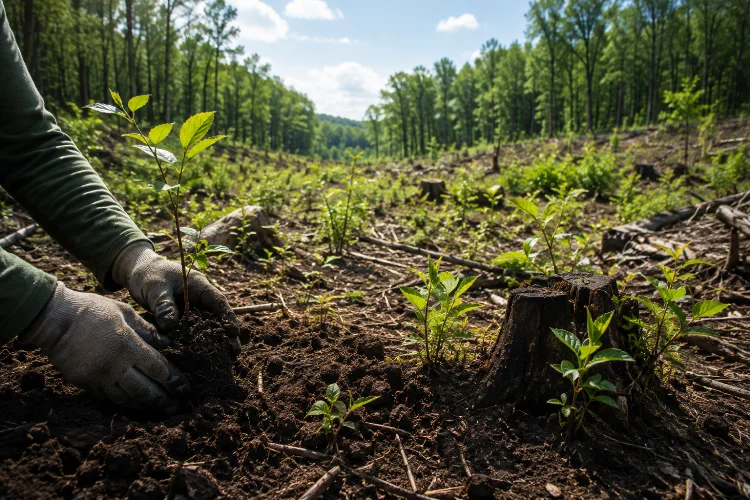
A forest does not stay the same forever. Trees grow old, storms knock them down, fires reshape landscapes, and harvesting can create large openings in the canopy. What happens next determines what the future forest will look like.
That process is known as forest regeneration. It involves establishing a new generation of trees after disturbance, harvesting, or the decline of an older stand.
Regeneration can happen naturally through seeds and sprouts, or people can actively establish trees through planting and direct seeding.
Understanding natural and artificial methods of forest regeneration is important because neither approach works perfectly everywhere.
A forest with abundant seedlings and nearby seed sources may recover with very little intervention. A severely degraded site, however, may require nursery-grown seedlings, site preparation, and years of maintenance.
Penn State Extension describes forest regeneration as both the process of re-establishing trees after disturbance and the young trees that will become the future forest.
Choosing the right method therefore means understanding ecology, management goals, cost, species requirements, and local site conditions.
What Does Forest Regeneration Actually Mean?
Forest regeneration is the process by which a new generation of trees becomes established.
It may begin after wildfire, wind damage, insect outbreaks, timber harvesting, agricultural abandonment, or simply the gradual death of older trees. The new forest can emerge through natural seed dispersal, stump sprouts, root shoots, planted seedlings, or directly sown seeds.
The important point is that regeneration is not simply about having a few small trees on the ground.
Successful regeneration requires enough desirable young trees to survive competition, herbivory, drought, disease, and other pressures until they become established members of the next forest.
Penn State notes that natural forest regeneration can occur through naturally dispersed seeds, stump sprouts, and root sprouts, while planting and seeding are considered artificial methods.
Foresters therefore think several years or even decades ahead when evaluating whether regeneration is actually working.
Natural Regeneration Relies on the Forest Itself
Natural regeneration allows trees to establish using biological processes already operating within the ecosystem.
Seeds may fall directly from mature trees, travel on the wind, or be transported by birds and mammals. Other tree species can regenerate through vegetative growth, including sprouts from stumps or roots.
One major advantage is that naturally regenerating seedlings often come from trees already adapted to local soil, climate, pests, and environmental conditions.
Natural regeneration can also be relatively inexpensive because managers may not need to purchase thousands of seedlings or organize large planting operations.
However, simply leaving land untouched does not always produce the desired result.
FAO explains that natural regeneration works best when enough young trees are already present, suitable seed sources remain nearby, and pressures such as repeated fire, grazing, or unsustainable harvesting can be controlled.
Natural Regeneration From Seeds
Seed-based regeneration is probably the most familiar natural method.
Mature trees release seeds, and some reach favorable locations where they can germinate. Wind disperses species such as maples, birches, and many conifers, while wildlife transports the seeds of numerous fruit-producing trees.
But producing lots of seed does not guarantee a new forest.
Seeds need suitable soil conditions, moisture, temperature, and light. Once germinated, seedlings must also compete with grasses, shrubs, ferns, and larger plants.
Shade tolerance matters too.
Penn State explains that foresters sometimes manipulate canopy openings because different tree species require different amounts of light for successful regeneration.
Shade-intolerant species generally need larger openings, while shade-tolerant species can survive beneath an existing canopy.
The existing forest structure therefore strongly influences which species successfully establish.
Sprouting Provides Another Natural Pathway
Not every new tree starts from a seed.
Many hardwood species can regenerate vegetatively after their stems are cut, damaged, or killed. New shoots may emerge from existing stumps or root systems.
This can give young trees an impressive advantage.
A seedling begins with a tiny root system, while a stump sprout may already be connected to the established roots of the previous tree. That access to stored energy and water can support extremely rapid early growth.
Penn State includes stump sprouts and root sprouts among the common mechanisms responsible for natural forest regeneration.
Sprouting is not equally important for every species, however. Some trees reproduce vigorously this way, while others depend much more heavily on seeds.
This is why foresters need to understand the biology of the species they are trying to manage.
Assisted Natural Regeneration Gives Nature a Helping Hand
There is also a middle ground between leaving a forest completely alone and planting every tree manually.
It is called assisted natural regeneration, or ANR.
Instead of replacing natural processes, managers identify existing seedlings and help them survive.
This may involve removing competing grasses, controlling invasive vegetation, protecting young trees from grazing, reducing repeated fire, or selectively clearing vegetation around desirable seedlings.
FAO describes assisted natural regeneration as a cost-effective restoration strategy in places where native vegetation is already capable of returning. It can also include enrichment planting when natural regeneration alone does not provide all the desired species.
This approach can be especially useful in degraded tropical landscapes.
The basic idea is simple: if the ecosystem is already trying to rebuild itself, management can focus on removing the barriers slowing it down.
Artificial Regeneration Gives Managers More Control
Artificial regeneration means people deliberately establish the next generation of trees.
The two major approaches are planting nursery-grown seedlings and direct seeding, where seeds are intentionally placed on the site.
Artificial methods are useful when natural seed sources are unavailable, desired species are poorly represented, regeneration has failed, or managers need greater control over tree spacing and composition.
The USDA Forest Service identifies planting and direct seeding as major artificial regeneration methods and notes that each method has its own benefits and limitations.
Artificial regeneration is common following intensive harvests, large wildfires, severe land degradation, and plantation establishment.
It can also support ecological restoration where managers want to reintroduce native species that are no longer abundant enough to return naturally.
Planting Seedlings Is the Most Controlled Approach
Tree planting gives managers considerable control over what grows and where.
Seedlings are normally raised in nurseries before being transported to the regeneration site. Foresters can select species, genetic stock, spacing, density, and planting locations according to specific goals.
Planting can be useful when rapid establishment is important or when competing vegetation makes natural seedling recruitment unreliable.
FAO guidance notes that planting success depends heavily on good site preparation, planting stock quality, soil moisture, suitable timing, and careful handling of seedlings. Planting when soil moisture is favorable can help reduce early stress.
There are disadvantages.
Growing, transporting, planting, and maintaining nursery seedlings requires labor and money. Newly planted trees may also experience transplant shock, drought, wildlife damage, or intense vegetation competition.
Planting thousands of trees is therefore only the beginning. Their long-term survival determines whether the project is actually succesful.
Direct Seeding Can Be Simpler and Cheaper
Direct seeding involves deliberately placing seeds in the field rather than first raising trees in a nursery.
The method can reduce costs associated with nursery production and seedling transportation.
FAO notes that direct seeding may be useful when slowly increasing tree cover or combining tree establishment with assisted natural regeneration. It can require less intensive site preparation than conventional planting in appropriate situations.
USDA Forest Service guidance also identifies direct seeding as potentially useful for large areas, burned land, or terrain where conventional planting may be difficult.
The trade-off is uncertainty.
Seeds can be eaten by wildlife, dry out, fail to germinate, or become overwhelmed by competing plants. Managers also have less control over the final spacing of successful trees.
Direct seeding works best when the chosen species, seed quality, weather, and site conditions are carefully matched.
Site Preparation Can Determine Success or Failure
Whether regeneration is natural or artificial, young trees need a suitable place to grow.
A site covered by dense grass, invasive shrubs, or thick competing vegetation may contain plenty of tree seeds yet produce very few surviving seedlings.
Site preparation can involve controlling competing vegetation, exposing suitable seedbeds, creating appropriate light levels, or preparing specific planting spots.
But aggressive preparation can create new problems.
FAO recommends avoiding unnecessary removal of ground vegetation because excessive disturbance can increase erosion, nutrient loss, and soil compaction.
Good site preparation is therefore not about making land completely bare.
It is about creating enough access to light, moisture, soil, and growing space for young trees without unnecessarily damaging the wider forest enviroment.
Natural and Artificial Regeneration Have Different Advantages
Natural regeneration can be affordable and ecologically well matched to local conditions. It can maintain locally adapted genetic diversity and allow forest succession to operate with relatively limited intervention.
Its weakness is unpredictability.
The desired species may produce too little seed, invasive vegetation may dominate, or regeneration may emerge unevenly across the site.
Artificial regeneration provides greater control. Managers can choose tree species, stocking levels, spacing, and sometimes improved genetic material.
The disadvantages include higher costs, labor needs, and the risk that planted trees are poorly suited to local conditions.
FAO’s assisted natural regeneration framework emphasizes that managers should first assess seed sources, existing seedlings, ecological conditions, and management objectives rather than automatically assuming planting is necessary.
Sometimes the best method is actually a combination of both.
Combining Methods Can Produce Better Results
Forest regeneration does not need to be an either-or decision.
Imagine a degraded forest where native seedlings are already appearing naturally, but several important tree species are missing.
Managers could protect the existing regeneration while planting only the missing species. This is often called enrichment planting.
Another site may rely mostly on natural seed dispersal while using direct seeding in areas located too far from mature seed trees.
FAO includes enrichment planting among the methods that can complement assisted natural regeneration.
Combining approaches can reduce costs while giving managers more control over future species composition.
It also avoids planting trees unnecessarily where natural processes are already doing the work.
How Foresters Choose the Right Regeneration Method
There is no single regeneration method that works best for every forest.
A forester needs to consider the desired future tree species, existing seedlings, nearby seed trees, soil conditions, light levels, wildlife pressure, competing vegetation, climate, costs, and management objectives.
Time matters as well.
A commercial forest may require reliable stocking within a particular period. A restoration project may be more willing to allow natural succession to unfold gradually.
The USDA Forest Service emphasizes that every regeneration method has advantages and disadvantages, which means managers should evaluate site-specific factors before choosing an approach.
The most sustainable choice is generally the least intensive method capable of achieving the desired ecological and management outcome.
That may mean natural regeneration in one location, planting in another, and a carefully designed mixture somewhere else.
Monitoring the Next Generation
Regeneration does not finish when seeds germinate or seedlings are planted.
Managers need to check whether young trees actually survive.
Monitoring can reveal poor stocking, browsing by deer or livestock, drought mortality, invasive plants, disease, or unexpected shifts in species composition.
Young trees may also need additional treatments as they grow.
Penn State highlights competing vegetation, browsing pressure, and available light as major factors influencing whether desirable forest regeneration survives and develops.
Early monitoring allows problems to be corrected before years of growth are lost.
Ultimately, a regneration project should be judged by the forest it produces, not simply by the number of seeds sown or seedlings planted on the first day.
Natural and artificial forest regeneration are different pathways toward the same basic goal: creating the next generation of forest.
Natural methods rely on seed dispersal, seedlings, stump sprouts, and root shoots, while artificial approaches use deliberate planting or direct seeding.
Neither method is automatically better. Natural regeneration can be inexpensive and well adapted to local ecosystems, while artificial regeneration provides greater control when seed sources or desirable species are limited.
The most effective strategy often combines ecological knowledge with practical management. Before deciding to plant, look first at what the forest is already capable of doing.
Existing seedlings, seed sources, soil conditions, competition, and disturbance history can reveal whether nature needs major intervention-or simply a little help.