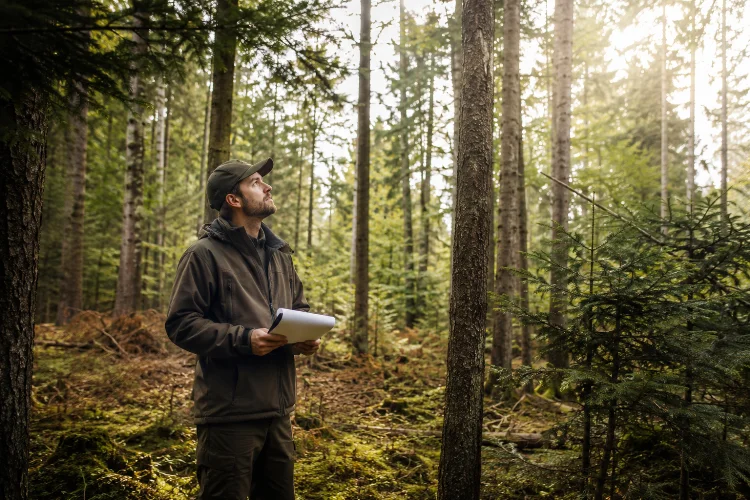
Forests may grow naturally, but managing them responsibly often requires careful decisions.
Which trees should be encouraged? When should crowded stands be thinned? How can timber be harvested without preventing the next generation of trees from developing?
These are the kinds of questions addressed by silviculture.
Understanding silviculture and its role in sustainable forest management means learning how foresters influence the establishment, growth, composition, health, and structure of forests over time.
Rather than simply cutting trees, silviculture involves guiding forest development toward specific ecological, economic, or social goals.
The USDA Forest Service describes silviculture as both the art and science of tending forests to meet human needs, while modern silvicultural research increasingly considers biodiversity, recreation, ecosystem services, and forest resilience alongside timber production.
When practiced well, silviculture can help maintain productive forests while protecting soil, water, wildlife habitat, and future regeneration. It is therefore one of the practical foundations of sustainable forestry.
What Exactly Is Silviculture?
Silviculture is the science and practice of controlling how forest stands establish, grow, develop, and regenerate.
The Food and Agriculture Organization defines natural-forest silviculture as controlling the establishment, growth, composition, health, and quality of forests to meet different needs and values.
Those purposes can include timber production, biodiversity conservation, recreation, and environmental services.
That definition is important because silviculture is sometimes misunderstood as simply a method for producing wood.
Modern forest management is much broader.
A silvicultural prescription could be designed to increase high-quality timber production, restore a degraded woodland, improve wildlife habitat, reduce competition during drought, encourage native trees, or develop a forest with several age classes.
The techniques may be similar, but the objectives can be very different.
Silviculture and Forest Management Are Not Exactly the Same
Silviculture and forest management are closely related, but they are not identical.
Forest management operates at a broader level. It includes planning, economics, regulations, roads, harvesting schedules, conservation goals, recreation, community needs, and long-term monitoring.
Silviculture focuses more specifically on the vegetation itself.
Think of sustainable forest management as the overall strategy and silviculture as one of its main biological toolkits.
FAO describes forest management as planning and implementing practices to meet environmental, economic, social, and cultural objectives.
Sustainable forest management aims to maintain and enhance those multiple forest values for both present and future generations.
A forest manager might decide that an area should provide timber, protect streams, maintain wildlife habitat, and remain resilient to wildfire. Silvicultural techniques are then chosen to help turn those goals into actual conditions on the ground.
Forest Regeneration Is the Starting Point
Every sustainable forest eventually needs another generation of trees.
For that reason, regeneration is one of the most fundamental concerns in silviculture.
Natural regeneration relies on seeds, sprouts, seedlings, or young trees already present within or near the forest. Artificial regeneration usually involves planting seedlings or sometimes direct seeding.
The best approach depends on tree species, site conditions, management objectives, and disturbance history.
For example, some tree species germinate and grow well beneath partial shade. Others require major openings because their seedlings need strong sunlight.
Silvicultural systems can manipulate canopy cover to create those conditions.
FAO notes that planning silvicultural interventions requires knowledge of existing stand structure and the ecological requirements of desired species, particularly during seed and seedling development.
Good regeneration planning also considers what happens decades later. Producing thousands of seedlings today means little if nearly all of them disappear because they lack enough light, moisture, or growing space.
Thinning Helps Manage Competition
Young forests often begin with far more trees than can eventually occupy the site.
As trees become larger, their crowns and roots increasingly compete for sunlight, water, nutrients, and space. Growth may slow, and weaker individuals eventually become suppressed.
Foresters can influence this process through thinning.
Thinning removes selected trees so the remaining individuals have more resources available. Depending on the objective, foresters may favor healthy trees, valuable timber species, drought-tolerant individuals, wildlife trees, or species that increase stand diversity.
FAO lists thinning among important silvicultural techniques used to improve stand growth and timber quality.
The goal is not always to maximize tree size.
In some forests, managers may deliberately retain several canopy layers and tree sizes to support biodiversity. In others, thinning may be used to change fuel conditions or improve resistance to drought.
The right density depends on the forest rather than one universal formula.
Silvicultural Systems Shape How Forests Develop
A silvicultural system describes the overall process used to tend, harvest, and regenerate a forest stand.
Different systems create very different forest structures.
1. Even-Aged Management
In an even-aged stand, most trees belong to roughly the same age group. Silvicultural methods can create relatively large openings so a new generation becomes established around the same period.
This approach can work well for species that need abundant sunlight.
However, even-aged management does not automatically mean removing every tree. Managers may retain individual trees, habitat structures, stream buffers, or patches for ecological reasons.
2. Uneven-Aged Management
Uneven-aged forests contain several age and size classes.
Individual trees or small groups may be harvested periodically while younger trees continue developing underneath or within canopy gaps.
This can maintain continuous forest cover and greater structural variation.
FAO explains that silvicultural systems can vary considerably depending on how existing trees are removed and how the next generation is recruited. The choice should reflect ecological characteristics, desired species, site conditions, regeneration status, and management objectives.
Neither system is automatically more sustainable. Sustainability depends on whether the chosen approach fits the ecosystem and the long-term goals.
Harvesting Can Be Part of Silviculture
Tree harvesting is often viewed as something separate from forest ecology, but harvesting can actually function as a silvicultural treatment.
Removing selected trees changes light, growing space, competition, habitat, and regeneration conditions.
The critical issue is how trees are removed and what the forest looks like afterward.
A well-designed harvest might release young trees from competition, create openings for light-demanding species, generate income, and retain important habitat structures.
Poorly planned harvesting can do the opposite.
Excessive removal may damage soil, reduce seed sources, simplify forest structure, harm water quality, or leave too few desirable trees for future regeneration.
FAO recommends integrating silviculture with harvesting operations and avoiding unnecessary interventions. Treatments should address clear objectives and account for ecological conditions and potential biodiversity impacts.
Sustainable harvesting therefore requires thinking beyond the timber leaving the forest.
The real silvicultural question is what kind of forest remains.
Silviculture Can Support Biodiversity
Sustainable silviculture does not require every hectare of forest to look neat or uniform.
In fact, ecological objectives often benefit from complexity.
Large old trees, young regeneration, standing dead trees, fallen logs, canopy gaps, shrubs, and different tree species can all create habitats for different organisms.
Managers may intentionally retain particular trees because they provide nesting cavities, seeds, fruits, shade, or future deadwood.
FAO specifically identifies biodiversity conservation and environmental services as legitimate purposes of silvicultural management. It also recommends protecting ecologically important species, including species valuable to wildlife.
A biodiversity-focused prescription might therefore look less “tidy” than a production-oriented plantation.
That is not poor management.
It simply reflects a different goal.
Silviculture Can Help Forests Respond to Climate Change
Climate change is making silvicultural decisions increasingly complicated.
Foresters can no longer assume that future growing conditions will exactly match those of the past.
Changing temperatures, drought patterns, wildfire behavior, storms, insects, and diseases may influence which tree species survive successfully in particular locations.
Silviculture can help managers respond by adjusting stand density, maintaining diverse species, protecting regeneration, or favoring individuals adapted to expected conditions.
Sustainable forest management increasingly includes climate adaptation and mitigation alongside traditional objectives. FAO notes that sustainable forestry contributes to biodiversity conservation, clean water, livelihoods, and responses to climate change.
However, no treatment can make a forest completely immune to extreme events.
Adaptive management is therefore essential.
Foresters need to monitor what happens after interventions and modify future decisions when results differ from expectations. Sustainable management is an ongoing process rather than a single permanant prescription.
Sustainable Silviculture Requires Understanding the Site
One of the biggest mistakes in forestry would be applying exactly the same treatment everywhere.
Forests differ enormously.
Soil depth, rainfall, elevation, slope, tree species, wildlife, past land use, fire history, markets, ownership, and local community needs can all influence management decisions.
FAO stresses that choosing a silvicultural system requires understanding forest type, site conditions, species composition, tree size distribution, regeneration, and the ecological requirements of desired species.
Social factors matter too.
A community forest managed for fuelwood, fruits, medicine, water protection, and local income may require very different treatments from an industrial timber plantation.
Sustainable silviculture begins by asking what the forest is expected to provide and which ecological limits should not be crossed.
Only then should foresters decide what intervention is appropriate.
Monitoring Turns Silviculture Into Adaptive Management
Silvicultural treatments should never be viewed as the end of the management process.
After thinning, planting, harvesting, or creating canopy openings, managers need to observe what actually happens.
Did seedlings establish?
Are desirable trees growing faster?
Has invasive vegetation expanded?
Is wildlife habitat improving?
Are erosion or soil impacts appearing?
Monitoring allows managers to compare outcomes with their original objectives and adjust later treatments.
FAO describes sustainable forest management as an iterative process in which monitoring helps identify corrective actions over time. Long-term forest values and resilience matter more than short-term changes within a single stand.
This is where forestry becomes both science and practice.
Managers use ecological knowledge to make a decision, observe the forest’s response, and then improve the next decision.
Why Silviculture Matters for Sustainable Forestry
Silviculture matters because simply leaving every forest alone or harvesting without long-term planning will not meet every ecological and social objective.
Some forests require restoration after degradation. Others need treatments to encourage regeneration, maintain specific habitats, produce renewable timber, or reduce excessive competition.
Good silviculture tries to balance these needs without undermining the forest’s future.
FAO describes sustainable forest management as maintaining economic, social, and environmental forest values for present and future generations.
Silviculture provides many of the practical techniques needed to achieve that goal.
When those techniques are based on forest ecology, careful planning, monitoring, and clearly defined objectives, they can support productive forests without treating them simply as timber factories.
Understanding silviculture means understanding how people can intentionally guide forest development while still working with natural ecological processes.
Regeneration, thinning, canopy management, harvesting, species selection, and monitoring can all influence what a forest looks like decades into the future.
Its role in sustainable forest management goes far beyond timber production. Modern silviculture can support biodiversity, wildlife habitat, water protection, climate resilience, recreation, and long-term forest productivity.
The key is matching each treatment to the forest’s ecology and management goals rather than applying the same solution everywhere. If you want to understand sustainable forestry more deeply, start by looking at forests as changing systems.
Every silvicultural decision made today can shape the trees, habitats, and ecosystem services available to the next generaton.