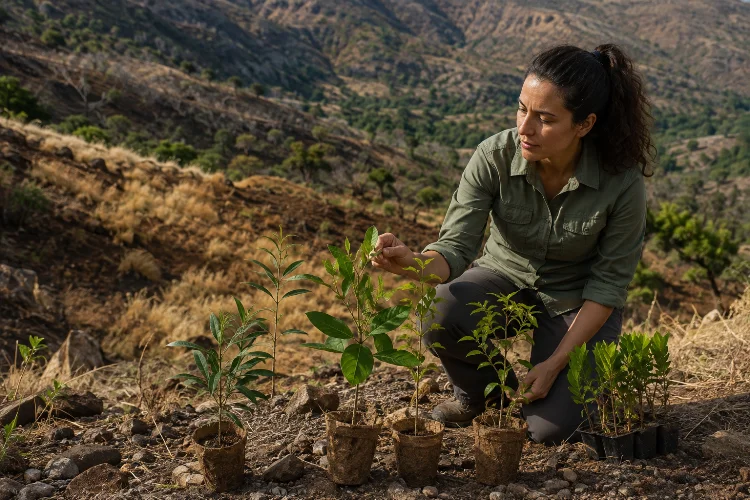
Planting trees sounds simple until you have to decide which trees should actually go into the ground. A species that grows beautifully in one location may struggle with drought, poor soil, flooding, pests, or intense competition somewhere else.
That is why learning how to select suitable tree species for forest restoration projects is one of the most important parts of ecological restoration.
Successful projects do not begin with a nursery catalog. They begin by understanding what the land needs, what kind of forest should return, and which species can realistically survive there.
The Food and Agriculture Organization emphasizes that restoration methods should reflect management objectives and the ecological potential of the site.
Site characteristics, existing vegetation, natural regeneration, available resources, and long-term management all influence the best approach.
Choosing the right species can improve survival, biodiversity, soil recovery, wildlife habitat, and climate resilience. Choosing poorly can leave a restoration project expensive, vulnerable, and ecologically disappointing.
In other words, successful restoration starts with the right tree-but also the right place and purpose.
Start With the Restoration Goal
Before choosing any species, ask a simple question: What are you trying to restore?
Not every forest restoration project has the same objective.
One project may aim to rebuild native biodiversity after agricultural abandonment. Another might stabilize eroding slopes, improve watershed protection, reconnect wildlife habitat, restore degraded timberland, or increase long-term carbon storage.
FAO recommends defining and prioritizing restoration objectives at the beginning because different goals may require different methods and vegetation choices.
For example, a project focused on wildlife habitat might prioritize native fruiting trees, flowering species, and trees that produce cavities or shelter. A watershed project may place greater emphasis on species that protect soil and tolerate wet conditions.
If commercial products are also important, managers might include native trees that provide timber, fruit, medicine, or other resources.
Species selection therefore starts with purpose, not popularity.
Match Tree Species to Local Site Conditions
Even a valuable native tree will fail if it is planted in the wrong environment.
Different species have different tolerances for temperature, rainfall, drought, flooding, soil texture, fertility, elevation, slope, and sunlight.
FAO notes that matching planting material to site conditions can make the difference between success and failure. Climate, terrain, soils, forest purpose, planting-stock availability, and silvicultural characteristics should all influence species choice.
Look at Soil and Water First
Some trees tolerate acidic or nutrient-poor soils, while others require relatively fertile conditions.
Drainage is equally important. A species adapted to dry slopes may develop serious root problems in waterlogged ground, while floodplain trees may struggle on exposed, drought-prone sites.
Before planting, restoration teams should examine soil type, drainage, seasonal rainfall, and water availability.
The existing vegetation can provide clues as well. Plants already surviving on the site often reveal whether conditions are dry, wet, fertile, degraded, shaded, or exposed.
The goal is not simply to find trees that can survive there, but species that can develop into a functioning forest under the site’s actual enviroment.
Prioritize Native Species Where Appropriate
Native tree species are usually central to ecological forest restoration.
They evolved within local or regional ecosystems and often have established relationships with native fungi, insects, birds, mammals, and other organisms.
Kew’s reforestation guidance recommends using diverse mixtures containing as many native species as practical when tree planting is necessary. Native mixtures can provide habitat, attract pollinators and seed dispersers, and support biodiversity recovery.
That does not mean every native species belongs on every site.
A native swamp tree still should not be planted on a dry ridge simply because it occurs somewhere in the same country.
Historical vegetation records, nearby reference forests, botanical surveys, local ecological knowledge, and remaining forest fragments can help identify species that naturally belong in the target ecosystem.
Non-native species require greater caution. Some may have legitimate production or rehabilitation roles, but invasive trees can spread outside planting areas, compete with local vegetation, change fire behavior, or alter water use.
The principle should be ecological suitability before convenience.
Choose a Mix Instead of Relying on One Species
Restoration is usually stronger when it rebuilds ecological diversity rather than creating a single-species stand.
Trees vary in crown structure, root depth, growth speed, shade tolerance, flowering time, drought response, and relationships with wildlife.
A mixture allows those traits to complement one another.
Research summarized by Nature indicates that tree diversity can improve forest productivity and stability because different species use resources in different ways and may respond differently to climatic stress.
Mixed restoration plantings can also reduce the risk that one pest, pathogen, drought, or extreme weather event damages the entire project.
Kew recommends selecting tree mixtures that maximize biodiversity and include species capable of interacting positively with fungi, pollinators, and seed-dispersing animals.
A good species mix might include fast-growing pioneer trees, slower-growing canopy species, fruiting trees, nitrogen-fixing plants, and species that provide long-term habitat.
The objective is not maximum species numbers for their own sake. It is a balanced community capable of becoming increasingly self-sustaining.
Think About Pioneer and Late-Successional Species
Forest restoration often needs trees with different ecological roles.
Pioneer species are usually among the first trees capable of establishing in open, disturbed conditions. Many grow quickly, tolerate strong sunlight, and help create shade.
That shade can reduce grasses and extreme soil temperatures, making the site more suitable for other species later.
Late-successional species often grow more slowly and may perform better beneath partial canopy cover.
Using both groups can help restoration follow natural forest development.
Kew’s work in Madagascar, for example, evaluates restoration trees according to traits such as resilience to harsh open conditions, fire resistance, rapid canopy development, reproduction, and ease of propagation.
Managers should therefore ask not only, “Will this tree survive?” but also, “What ecological job will this tree perform?”
Some species prepare the site. Others create future canopy structure or provide fruit and habitat once the forest matures.
Consider Wildlife and Ecological Relationships
Trees function as part of ecological networks.
A restoration tree may provide nectar for insects, fruit for birds, shelter for mammals, or resources for mycorrhizal fungi. Wildlife may then help move seeds and accelerate natural forest recovery.
This is particularly valuable when the goal is to create a forest capable of continuing regeneration without constant planting.
Kew and BGCI describe a restoration project in northern Thailand where 14 native tree species, including figs and legumes, were planted. As the canopy developed, macaques began visiting fruiting trees and dispersing additional seeds, helping natural regeneration expand.
This illustrates an important idea: restoration species should not be evaluated as isolated trees.
Ask what happens around them.
Species that attract seed dispersers, improve soil, support fungi, provide food, or create nesting habitat can accelerate the recovery of a much wider ecosystem.
Protect Genetic Diversity and Choose Good Seed Sources
Species identity is only part of the selection process.
Where the seed comes from matters too.
Trees within the same species can contain significant genetic variation. That variation affects characteristics such as growth, drought tolerance, flowering time, disease resistance, and adaptation to local climate.
BGCI recommends maintaining high genetic diversity and tracking seed provenance in restoration programs. Using planting material with very limited genetic variation can reduce the adaptive capacity of future forests.
Seed should generally be collected from multiple healthy parent trees rather than repeatedly from one or two convenient individuals.
BGCI’s Hong Kong restoration work, for example, collects seeds from multiple populations where possible to increase genetic diversity in restored forests.
This becomes especially important when restoration is expected to last for centuries.
The trees planted today need enough genetic options to reproduce and adapt under conditions we cannot predict perfectly.
Plan for a Changing Climate
Using historical forest composition is helpful, but the past should not be the only guide.
A location that was suitable for a particular tree 50 years ago may become warmer or drier over the lifetime of seedlings planted today.
Restoration practitioners increasingly need to consider projected climate conditions.
Kew recommends selecting resilient species and using seeds with suitable genetic diversity for both current and expected future conditions.
FAO similarly notes that some forest managers are considering provenances from warmer regions or mixtures of provenances as climate risks increase.
This does not mean automatically replacing native forests with heat-tolerant exotic trees.
Instead, restoration planning can examine drought tolerance, fire resistance, expected rainfall, elevation limits, and genetic variation within native species.
Climate-smart restoration aims to produce a forest that belongs to the landscape while still having enough resiliance to survive future change.
Check Whether the Trees Can Actually Be Produced
An ecologically perfect species list is useless if suitable seeds and seedlings cannot be obtained.
Native seed supply is one of the practical bottlenecks in many restoration programs.
BGCI’s current work in Africa specifically focuses on expanding the availability of high-quality, locally provenanced native seeds and seedlings because limited supply often pushes restoration programs toward a narrow range of easily available species.
Before finalizing a planting plan, managers should investigate seed collection seasons, germination requirements, nursery capacity, seed storage behavior, propagation techniques, and cost.
Some native trees are easy to propagate. Others have complicated dormancy requirements or produce seeds only during short seasonal windows.
Planning early matters.
Kew recommends establishing seed supply chains and nursery capacity well in advance rather than choosing species immediately before planting begins.
A slightly smaller but well-sourced species mix is usually better than an ambitious list that cannot be produced reliably.
Test, Monitor, and Adjust the Species Mix
Species selection should not end when planting begins.
Restoration is a long-term experiment.
Managers should monitor survival, growth, drought damage, herbivory, disease, competition, natural regeneration, and wildlife use.
Some species may perform much better than expected. Others may fail despite appearing suitable on paper.
Kew’s restoration principles include “learn by doing,” combining scientific information, field experiments, and local or Indigenous knowledge to improve later decisions.
Small pilot plots can be especially useful before planting thousands of hectares.
If several tree combinations are tested under real conditions, managers can identify which mixtures perform best and adjust future planting.
A succesful restoration program is therefore adaptive. It does not depend on getting every decision perfectly right on day one.
Selecting suitable tree species for forest restoration requires much more than choosing trees that grow quickly.
The strongest projects begin with clear restoration goals and then match species to soil, water, climate, elevation, ecological relationships, and future environmental conditions.
Native species, diverse mixtures, appropriate functional traits, and genetically varied seed sources can all help create forests that are healthier and more adaptable. Practical factors such as nursery capacity and seed availablity matter just as much.
Most importantly, treat species selection as an ongoing process. Observe how trees perform, learn from nearby natural forests and local communities, and adjust the planting strategy when necessary.
Restoration succeeds when planted trees eventually become part of a functioning ecosystem capable of growing, reproducing, and changing without constant human assistance.