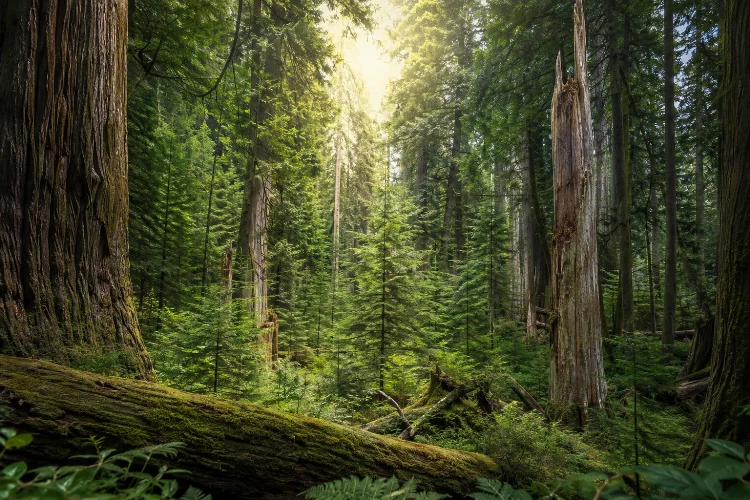
Walk into two forests of the same size and you may find completely different environments.
One might contain hundreds of similarly sized trees packed closely together, while another has giant old trees, younger saplings, canopy gaps, standing deadwood, and several vegetation layers.
Those differences are examples of forest stand structure.
Understanding forest stand structure for better management decisions means looking at how trees and other vegetation are arranged within a particular area.
Foresters examine tree density, diameter, height, age, canopy position, species composition, regeneration, and deadwood to understand how a stand is developing and how it might respond to management.
Oregon State University Extension notes that stand density influences tree size, crown development, understory vegetation, growth, and competition. These characteristics are directly connected to objectives ranging from timber production to wildlife habitat.
Reading forest structure is therefore a little like reading a biography. The trees reveal what happened in the past, what is happening now, and what management choices might shape the forest decades from today.
What Is Forest Stand Structure?
A forest stand is generally an area of forest that is similar enough in composition, age, condition, or structure to be treated as a recognizable management unit.
Stand structure describes how its biological components are arranged.
Foresters often examine the number of trees, their sizes, heights, crown positions, species, and spatial distribution. They may also record seedlings, shrubs, standing dead trees, and fallen logs.
Structure can be horizontal or vertical.
Horizontal structure describes how trees are distributed across the ground. They might be evenly spaced, clustered in groups, or scattered irregularly.
Vertical structure describes layers from the forest floor to the upper canopy. A structurally simple stand may have one main tree layer, while a more complex forest can contain shrubs, saplings, intermediate trees, and several canopy levels.
Research from the USDA Forest Service shows that structural complexity is closely connected to ecological complexity and biodiversity, particularly in older forests.
Tree Density Shows How Crowded a Forest Is
One of the first things foresters often measure is tree density.
At its simplest, density can mean the number of trees growing within a given area. But counting stems alone does not tell the entire story.
One hundred very large trees use resources differently from one hundred small saplings.
That is why foresters also use measurements such as basal area, which describes the cross-sectional area occupied by tree stems at breast height. Diameter measurements help managers understand how much growing space trees are using.
Oregon State University explains that competition increases as stands become denser. This influences tree growth rates, crown size, diameter, stand volume, and the amount of vegetation surviving beneath the main canopy.
A crowded young forest may therefore need different management from a relatively open mature woodland.
Thinning can reduce density and give remaining trees greater access to sunlight, water, nutrients, and physical growing space. USDA Forest Service research identifies thinning as one of the most important tools available for influencing stand development and structure.
Diameter Classes Reveal the History of a Stand
Tree diameter provides another valuable clue.
Foresters commonly measure diameter at breast height, or DBH, at about 4.5 feet above the ground. Looking at the distribution of diameters across the stand can reveal whether most trees are similar in size or whether several size classes are present.
Even-Aged and Uneven-Aged Structures
An even-aged forest usually contains trees established during roughly the same period.
A stand created after a major wildfire, clearcut harvest, or other large disturbance may eventually contain many trees with similar ages and sizes.
An uneven-aged stand contains several generations.
Large mature trees may grow beside smaller trees, saplings, and seedlings. The resulting diameter distribution can show that regeneration has occurred repeatedly rather than during one major event.
This information matters because management treatments can change future diameter patterns.
A manager trying to maintain continuous canopy cover might favor small-group or individual-tree openings. Another managing a light-demanding species may create larger openings that establish a new age class.
Forest strucure therefore reflects both natural disturbance history and previous management.
Canopy Layers Control Light and Habitat
Looking upward provides another important part of the picture.
Forest canopies determine how much sunlight reaches lower vegetation. They also create habitat for insects, birds, mammals, epiphytes, and countless other organisms.
Some forests contain a relatively uniform canopy where most tree crowns occupy similar heights.
Others contain multiple layers.
Large dominant trees may rise above the general canopy, medium-sized trees occupy intermediate positions, and shade-tolerant saplings grow underneath.
USDA Forest Service research describes the canopy as the location of major ecosystem processes such as photosynthesis and evapotranspiration, while also providing habitat for diverse forest organisms.
Canopy structure can therefore influence much more than timber growth.
When managers thin a stand or create gaps, they change how light moves through the forest. More sunlight may stimulate understory vegetation and tree regeneration, while retaining canopy cover can help maintain shade and cooler conditions.
The right structure depends on the management objective.
Regeneration Shows Whether a Forest Has a Future
Large trees may dominate what visitors see, but foresters also look closely at what is happening near the ground.
Seedlings and saplings reveal whether the next generation of trees is becoming established.
A mature forest with almost no young trees may eventually face a regeneration problem. In contrast, abundant seedlings of several desired species can show that natural renewal is already underway.
Regeneration can come from newly germinated seeds, seedlings that existed before harvesting, stump sprouts, or root suckers. USDA Forest Service regeneration models recognize all of these pathways as potential sources of a new tree cohort.
Managers need to examine more than seedling numbers.
They should consider species, height, browsing damage, competition, light conditions, and whether young trees are distributed across enough of the stand.
A forest can contain thousands of seedlings and still have poor long-term regneration if nearly all belong to undesirable or invasive species.
Dead Trees Are Part of Forest Structure Too
Standing dead trees and fallen logs might initially look like waste, but they are important structural components.
Standing dead trees, often called snags, provide nesting cavities, feeding sites, and shelter for wildlife.
Downed woody material supports insects, fungi, microorganisms, mosses, and small animals. As wood decomposes, it also contributes organic material to the forest floor.
Classic USDA Forest Service research on old-growth Douglas-fir forests identified large live trees, large snags, and large fallen logs among the key structural components that distinguish older forests from many younger stands.
Studies comparing managed and unmanaged northern hardwood forests have also found differences in the quantity and size of standing and fallen deadwood. Older forests tended to contain larger pieces and greater structural complexity.
This is why modern ecological forestry often retains some deadwood instead of removing every damaged or fallen tree.
Structural Complexity Supports Different Management Goals
There is no single perfect forest structure.
The ideal condition depends on why the forest is being managed.
A stand managed for high-quality timber may prioritize healthy crop trees, controlled spacing, and predictable regeneration.
Wildlife management may emphasize large trees, cavities, shrubs, canopy gaps, deadwood, and several vegetation layers.
A forest managed for recreation might require another combination, while wildfire-risk reduction can involve lowering certain types of stand density or fuel continuity.
Ecological forestry increasingly uses natural stand development and disturbance processes as models for management.
USDA Forest Service researchers argue that retaining biological legacies, encouraging structural variation through thinning, and allowing adequate recovery periods between disturbances can help develop more complex stands.
The important lesson is that managers should first define the desired future condition.
Only then should they decide which structural features need to be maintained, created, or reduced.
Structure Changes Naturally as Forests Develop
Stand structure never stays fixed.
Young forests often begin with many small trees. As competition increases, some individuals die while surviving trees grow larger.
Later, storms, disease, insects, or normal mortality can create canopy openings. Younger trees then grow into those gaps.
Over many decades, the forest may develop increasingly varied tree sizes, deadwood, canopy layers, and patches in different stages of development.
Natural disturbance is central to this process.
USDA Forest Service research emphasizes that individual tree mortality, disturbance, biological legacies, and recovery periods all contribute to structural and compositional variation in forests.
Managers therefore need to understand that a stand inventory is only a snapshot.
Management decisions should consider where the forest is heading as well as what it looks like today.
Using Stand Structure to Make Better Decisions
A good forest inventory turns observations into useful information.
Managers can measure tree species, DBH, height, basal area, density, regeneration, canopy position, and deadwood. Repeating measurements over time reveals whether the forest is changing in the desired direction.
For example, slowing diameter growth in a crowded stand might suggest that competition is becoming intense.
A lack of seedlings could indicate a need to modify light conditions or address browsing pressure.
Too little structural diversity might encourage managers to retain larger trees, create variable-density gaps, or protect deadwood depending on the objective.
Monitoring is especially important after treatments such as thinning.
Reducing stand density generally increases resource availablity for remaining trees and may encourage understory development, but the exact response varies with species, climate, soil, and treatment intensity.
Forest managment works best when decisions are followed by observation and adjustment rather than assuming one treatment will produce permanent results.
Forest stand structure tells us far more than how many trees occupy a piece of land.
Tree density, diameter classes, canopy layers, regeneration, species composition, deadwood, and spatial patterns together reveal how a forest functions and where it may be heading.
Understanding those features helps managers choose treatments that match specific objectives, whether the priority is timber, biodiversity, wildlife habitat, restoration, resilience, or a combination of several goals.
The key is not to create one supposedly perfect structure everywhere. Different forest types and management goals require different conditions.
Start by measuring what is already present, define what the future forest should provide, and monitor how it responds over time. Better decisions begin with learning to read the structure that the forest is already showing you.