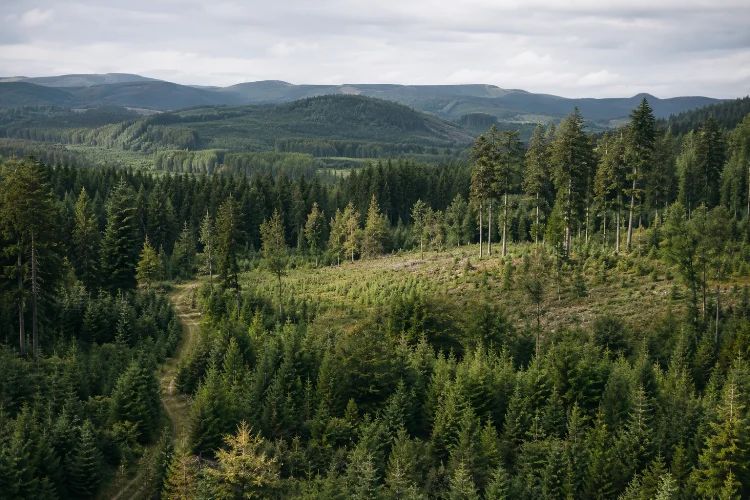
Forests constantly change as trees grow, compete, die, and regenerate. Forest managers can allow many of these processes to happen naturally, but they can also guide them through carefully planned treatments designed to create particular forest conditions.
This is where silvicultural systems become important.
Understanding the main silvicultural systems used in forest management means looking at how mature trees are removed, how new trees become established, and what kind of stand structure develops afterward.
Some systems create forests where most trees are approximately the same age, while others maintain several generations growing together.
According to the FAO, a silvicultural system is the process through which forest stands are tended, removed, and replaced, eventually producing stands with distinctive structures.
Choosing the appropriate system depends on management objectives, forest type, species composition, site conditions, regeneration, and the ecological needs of desired trees.
The important point is that there is no universally “best” system. Good forestry means choosing the approach that fits the forest.
What Is a Silvicultural System?
A silvicultural system is more than a method for harvesting trees.
It covers the complete sequence of activities used to establish, develop, tend, harvest, and regenerate a forest stand. Harvesting may be the most visible part, but regeneration is usually what defines the long-term result.
The USDA Forest Service traditionally groups several major systems as clearcutting, seed-tree, shelterwood, and selection systems. Each produces different conditions for the next generation of trees.
Other forest traditions also use coppice and related vegetative systems.
At a broader level, these methods can be grouped into two general categories: even-aged systems and uneven-aged systems.
Even-Aged and Uneven-Aged Systems
Understanding this distinction makes the individual systems much easier to follow.
1. Even-Aged Silviculture
An even-aged system creates a stand in which most trees belong to roughly the same age class.
Clearcutting, shelterwood, and seed-tree approaches are generally used to produce this type of forest structure. Their regeneration periods may differ, but they eventually create a relatively distinct new generation.
Even-aged management can be particularly useful for tree species that require substantial sunlight during early development.
2. Uneven-Aged Silviculture
Uneven-aged management maintains several tree ages or size classes at the same time.
Instead of replacing an entire stand within a relatively short regeneration period, managers periodically remove selected trees or groups. Smaller trees continue growing while new seedlings establish in openings.
FAO broadly describes these contrasting approaches as monocyclic or uniform systems versus polycyclic or selective systems.
Neither structure is automatically more sustainable. The correct choice depends on species ecology, management goals, biodiversity needs, harvesting requirements, and local conditions.
The Clearcutting System
Clearcutting is probably the most familiar-and most debated-silvicultural system.
In a true clearcutting system, most or all trees within a defined stand are removed during one main harvest to create conditions for a new, even-aged generation. The harvested area then regenerates naturally or through artificial planting.
The USDA Forest Service describes clearcutting as harvesting trees in one operation specifically to establish a new even-aged stand.
When Clearcutting Can Work
Clearcutting can be appropriate for species that need abundant sunlight and do not regenerate successfully beneath a dense canopy.
It can also imitate some effects of large natural disturbances, such as severe wildfire or major wind events, although a harvested landscape is obviously not ecologically identical to a naturally disturbed forest.
The system gives managers considerable control over regeneration and can make harvesting operationally efficient.
However, the size and design of openings matter.
Poorly planned clearcuts can increase visual impacts, reduce habitat structure, expose soils, and simplify forest conditions. Modern approaches may retain stream buffers, wildlife trees, deadwood, habitat patches, or other biological legacies.
The Shelterwood System
Shelterwood management takes a more gradual approach.
Instead of removing the mature stand all at once, managers remove it through a sequence of cuts. Part of the older canopy remains temporarily while the next generation establishes underneath.
The USDA Forest Service explains that regeneration develops beneath a partial canopy before the remaining shelter trees are eventually removed, producing an even-aged stand.
This partial canopy can provide shade, seed, and protection from harsh conditions.
A typical shelterwood approach may include a preparatory treatment, a regeneration or seed cut, and a later removal cut. The exact sequence varies according to forest type and management goals.
Shelterwood systems are especially useful where seedlings benefit from moderate shade or where managers want greater control over competing vegetation.
The trade-off is complexity. Multiple entries can increase operational costs and require careful timing and maintanance.
The Seed-Tree System
The seed-tree system sits somewhere between clearcutting and shelterwood management.
Most mature trees are harvested, but a small number of healthy, well-distributed trees are deliberately retained.
Their job is straightforward: produce seed.
Once enough seedlings become established, the seed trees may eventually be removed or retained for other ecological or management purposes.
USDA Forest Service guidance notes that this approach has traditionally been applied particularly to conifers capable of distributing seed effectively across open sites.
The method works best when retained trees produce reliable seed crops and those seeds can travel far enough to regenerate the harvested area.
If seed production fails or competing vegetation dominates quickly, regeneraton can become unreliable. Managers therefore need to consider seed years, dispersal distances, soil conditions, and establishment requirements before choosing the system.
The Selection System
Selection systems are fundamentally different from the previous three because they are designed to maintain uneven-aged forest structure.
Trees are periodically harvested either individually or in small groups.
New seedlings establish within the resulting openings, while other trees remain standing and continue developing.
The USDA Forest Service identifies two common variations: single-tree selection and group selection.
1. Single-Tree Selection
Single-tree selection removes individual trees scattered throughout the stand.
The resulting gaps are usually small, so conditions tend to favor shade-tolerant species capable of regenerating beneath partial canopy cover.
Frequent monitoring is important because repeatedly removing only the largest and most valuable trees without managing regeneration and stand structure is not proper selection silviculture.
2. Group Selection
Group selection removes small groups of trees rather than isolated individuals.
The larger openings provide more sunlight, allowing managers to encourage species that are less shade tolerant while still maintaining a generally uneven-aged forest.
Selection systems can maintain continuous canopy cover and diverse tree sizes, but they require careful planning. Managers need to balance harvesting with recruitment into younger and intermediate size classes.
Coppice Systems Use the Tree’s Ability to Resprout
Not every forest needs to regenerate primarily from seeds.
Many broadleaf tree species can produce new shoots from stumps or roots after being cut. Silvicultural systems that deliberately use this ability are called coppice systems.
FAO describes coppice stands as forests originating mainly from vegetative shoots following cutting.
Because sprouts already have access to established root systems, early growth can be remarkably fast.
Traditional coppice systems often operate on relatively short rotations for products such as fuelwood, poles, small timber, or other materials.
Coppice With Standards
A variation called coppice with standards combines vegetative regeneration with larger trees grown from seed.
The coppice layer is harvested periodically while selected standard trees remain for much longer periods. The result is a multi-layered forest containing trees managed on different rotations.
This approach illustrates how silvicuture systems can combine different regeneration strategies rather than relying on one rigid formula.
Continuous-Cover Forestry Is an Emerging Management Approach
Another concept increasingly discussed in modern forestry is continuous-cover forestry.
Rather than using large-scale stand replacement, managers try to maintain forest cover while harvesting trees through smaller-scale interventions.
Selection methods, irregular shelterwood treatments, and other approaches may all contribute to continuous-cover management depending on the region and terminology used.
The objective is often to maintain diverse stand structures, reduce major canopy disruptions, encourage natural regeneration, and provide a continuous range of ecosystem services.
However, continuous cover is not automatically appropriate everywhere.
Highly light-demanding species may struggle to regenerate if canopy openings remain too small. Harvesting can also become operationally more complicated.
The broader lesson is that silvicultural systems must work with species ecology rather than forcing every forest into the same structure.
How Managers Choose the Right Silvicultural System
Selecting a system begins with understanding the forest.
FAO recommends considering forest type, site conditions, species composition, diameter distribution, desired tree sizes, existing regeneration, and the ecological requirements of seedlings.
Economic resources, local needs, expected products, regulations, and forest resilience should also influence the decision.
Light requirements are especially important.
Shade-intolerant trees often need large canopy openings. Shade-tolerant species may establish successfully through smaller gaps or beneath partial canopy cover.
Managers also need to define what they want the future forest to provide.
A timber-production forest may require a different structure from a watershed protection area, wildlife reserve, recreation forest, or community woodland.
The best system is therefore the one that connects the desired future forest with the biological reality of the site.
Silvicultural Systems Should Include More Than Harvesting
A common mistake is treating a silvicultural system as nothing more than the final harvest method.
Harvesting is only one stage.
A complete system can include regeneration planning, site preparation, vegetation control, thinning, improvement treatments, harvesting, and monitoring.
FAO emphasizes that silvicultural interventions should be integrated with harvesting operations while avoiding treatments intense enough to unnecessarily damage soil or residual vegetation.
Regeneration is particularly important.
If trees are removed but the desired next generation cannot establish, the system has failed regardless of how efficiently timber was harvested.
Good forest management therefore asks what happens after trees leave the site.
Sustainability Depends on Applying the System Correctly
No silvicultural system is inherently perfect or inherently destructive.
Clearcutting may successfully regenerate sun-loving species in one forest but be completely inappropriate in another. Selection management can maintain complex structure, but poorly executed selection can gradually remove valuable trees without ensuring replacement.
Shelterwood systems can provide excellent regeneraton conditions but require several carefully timed operations.
Coppicing can produce renewable material efficiently where species resprout strongly, yet it is unsuitable for trees that depend entirely on seed reproduction.
FAO emphasizes that silvicultural systems developed partly to balance ecological, socioeconomic, market, and technical requirements.
Sustainability therefore comes from matching the system to the enviroment, implementing it properly, monitoring the results, and adapting management when conditions change.
The main silvicultural systems provide different ways to guide forest regeneration and development. Clearcutting, seed-tree, and shelterwood methods generally create even-aged stands, while selection systems maintain several generations of trees.
Coppice systems take advantage of vegetative sprouting, and continuous-cover approaches emphasize retaining forest canopy through smaller interventions.
None of these methods should be chosen simply because it is familiar or inexpensive. Tree biology, light requirements, existing regeneration, soil conditions, biodiversity, management objectives, and economic realities all matter.
When evaluating a forest, start by asking what future condition is desired and how the next generation of trees will become established.
Once those questions are answered, the appropriate silvicultural system becomes much easier to identify-and sustainable management becomes far more achievable.