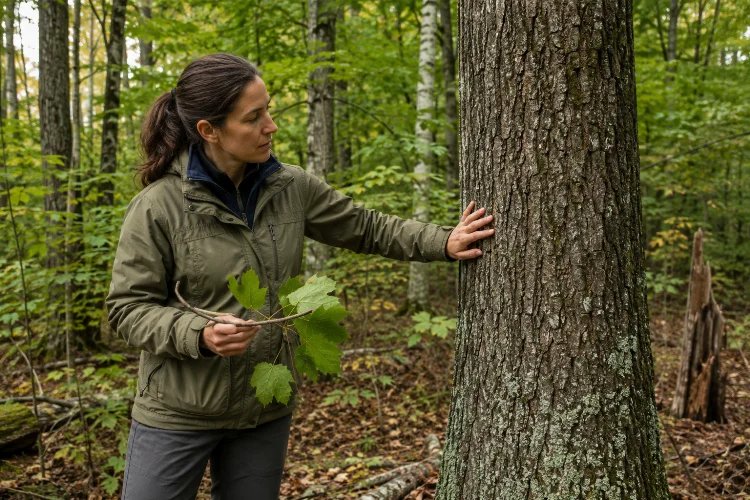
At first glance, identifying a tree seems easy. Look at the leaves, compare them with a picture, and find the name.
Then you walk into a diverse forest and discover that several trees have almost identical leaves, one has no leaves at all, and another looks completely different because it is still young.
This is where dendrology becomes useful.
Dendrology is the study of trees and other woody plants, especially their identification, classification, characteristics, distribution, and ecological relationships.
It gives foresters, botanists, conservationists, students, and curious nature lovers a systematic way to understand the trees around them.
Virginia Tech’s dendrology resources, for example, use leaves, twigs, buds, bark, flowers, fruits, and other characteristics to distinguish more than 1,000 North American woody plants.
Understanding dendrology and why tree identification matters goes far beyond memorizing names.
Correct identification helps us understand forest composition, choose appropriate management practices, recognize threatened species, monitor ecological change, and even diagnose tree-health problems.
Learning a tree’s name is often the first step toward understanding its role in the forest.
What Exactly Is Dendrology?
The word dendrology comes from Greek roots associated with trees and study. In modern forestry and botany, the field focuses mainly on woody plants, including trees, shrubs, and sometimes vines.
Dendrologists examine characteristics that help distinguish one species from another. These include leaf shape, branching pattern, bark texture, buds, flowers, fruits, seeds, wood, and geographic distribution.
That makes dendrology slightly different from simply learning common tree names.
A person might know that something is an oak, for example, while dendrological identification aims to determine which oak species it is and how it differs from related species.
Virginia Tech’s dendrology program provides traditional leaf and twig identification keys alongside detailed species fact sheets, illustrating how several characteristics are often combined before reaching an identification.
The goal is reliable identifcation, not guessing based on one familiar feature.
Tree Classification Gives Every Species a Place
Tree identification becomes much easier once you understand basic plant classification.
Species are organized into groups such as families and genera based on shared characteristics and evolutionary relationships.
For example, oaks belong to the genus Quercus, while maples belong to Acer. Within those genera are many individual species with their own ecological requirements and physical characteristics.
Scientific names are particularly useful because common names can vary between regions.
One tree may have several local names, while the same common name can occasionally describe different plants. Scientific classification creates a more standardized system.
This matters in professional forestry.
If a forest inventory, restoration plan, or conservation database records the wrong species, later decisions can also become inaccurate.
FAO specifically describes good tree-species identification as a fundamental requirement of forest inventory, noting that an identification error can be more serious than mistakes in several other tree measurements.
Leaves Are Usually the First Identification Clue
Leaves are one of the easiest places to begin.
A dendrologist may first ask whether the tree has needles, broad leaves, or scales. From there, details become more specific.
Broad leaves can be simple or compound. Their arrangement along a twig may be opposite, alternate, or whorled. Their edges may be smooth, toothed, or lobed.
Even the shape of a leaf base or tip can provide useful information.
The Arbor Day Foundation’s tree identification system uses a step-by-step approach based heavily on leaf characteristics, while its wider tree guide provides information about hundreds of tree and shrub species.
However, leaves should not be treated as the only clue.
Young shoots sometimes produce leaves that look different from mature ones. Seasonal variation, insect damage, drought, or hybridization can also complicate identification.
And in winter, deciduous trees may have no leaves at all.
Bark, Twigs, Buds, and Fruit Provide Extra Evidence
Good tree identification is a little like detective work. The more clues you collect, the stronger your conclusion becomes.
Bark can be smooth, peeling, deeply furrowed, plated, flaky, or patterned in distinctive ways.
Twigs provide another useful set of clues.
Their thickness, color, hairs, scars, smell, and arrangement can help distinguish species. Bud shape and position become particularly valuable during winter when leaves are absent.
Flowers, cones, berries, nuts, pods, and other fruits can sometimes provide the strongest evidence of all.
The Virginia Department of Forestry recommends using features such as bark, acorns, nuts, leaves, illustrations, and identification keys when distinguishing trees.
The Arbor Day Foundation likewise emphasizes flowers, fruits, twigs, buds, and bark as important clues beyond leaves.
Experienced observers rarely depend on just one feature.
Location and Habitat Can Narrow the Possibilities
Sometimes the best identification clue is not on the tree itself.
Look around it.
Trees have ecological preferences. Some thrive in wetlands, others on dry ridges. Certain species prefer acidic soils, river floodplains, high elevations, coastal environments, or disturbed ground.
Geographic range matters too.
If two nearly identical species occur on opposite sides of a continent, knowing where you are can quickly narrow the possibilities.
The USDA PLANTS database provides identification tools and plant information useful for connecting plant characteristics with geographic and conservation information.
This is why field identifcation works best when morphology and ecology are used together.
A leaf may suggest several possible species, while soil moisture, elevation, associated plants, and geographic range may reduce the list to one.
Learning habitat preferences also turns tree identification into a lesson in forest ecology.
Tree Identification Is Essential for Forest Management
Imagine trying to manage a forest without knowing which trees are growing there.
You would not know which species require full sunlight, which tolerate shade, which regenerate after fire, or which are valuable to wildlife.
Silvicultural decisions depend heavily on species composition.
FAO notes that managers planning interventions need information about forest type, species composition, ecological relationships, regeneration, and the requirements of desirable tree species.
Correct identification affects thinning, harvesting, regeneration, restoration, and habitat-management decisions.
Suppose a forester wants to encourage a particular native oak. Accidentally removing its seedlings while protecting a similar but less desirable species could shift the future composition of the stand.
The same problem can occur during vegetation control. FAO warns that forest treatments can be affected by errors or carelessness in species identification.
Knowing what you are looking at is therefore a practical management skill, not just botanical trivia.
Forest Inventories Depend on Accurate Species Data
Tree identification is also fundamental to forest inventory and monitoring.
Inventory crews measure characteristics such as tree diameter, height, condition, abundance, and species.
These observations are later used to estimate forest area, timber volume, carbon storage, biodiversity, regeneration, and changes through time.
The USDA Forest Service Forest Inventory and Analysis program maintains standardized field procedures and species lists for nationwide forest monitoring. Its current field guide establishes consistent methods for collecting inventory data.
Species identity gives those measurements ecological meaning.
Knowing there are 200 trees in a plot tells you something about density. Knowing which species those 200 trees represent tells you much more about habitat, forest composition, commercial value, vulnerability, and likely future development.
That is why accurate taxonomy forms part of the foundation of good forest data.
Identification Matters for Biodiversity Conservation
You cannot protect a species if you do not know it is there.
This is one of the strongest reasons dendrology matters for conservation.
Rare trees can easily be overlooked when they resemble common relatives. Accurate field surveys allow researchers to document distributions, identify important populations, and recognize areas with unusually high species richness.
FAO estimates that there are roughly 58,000 tree species globally and emphasizes that tree genetic resources have environmental, economic, scientific, and societal value.
Conservation assessments also depend on knowing where species occur.
Research supported by the USDA examining trees native to the contiguous United States identified 881 species and estimated that around 11-16% were threatened with extinction.
Accurate checklists and distribution records help conservationists determine which species require the greatest attention.
Correct identification is therefore closely linked with effective conservaton planning.
Tree ID Can Help Detect Pests and Ecological Change
Knowing the host species is often an important first step when investigating tree damage.
Many insects and pathogens target particular trees or groups of closely related species.
If you cannot identify the host, diagnosing the problem becomes much harder.
Species knowledge can also help detect longer-term environmental changes. Forest inventories repeated over decades may reveal that certain trees are becoming more common while others decline.
Those shifts can be associated with disturbance, invasive species, deer browsing, disease, climate, land-use history, or changes in forest management.
Understanding the species involved makes the pattern interpretable.
A forest is not simply becoming “more green” or “less green.” Its biological community is changing, and different tree species can tell differnt ecological stories.
How Beginners Can Get Better at Tree Identification
The fastest way to improve is to stop trying to memorize an entire forest at once.
Start with common local trees.
Learn a few contrasting species and become familiar with their leaves, branching patterns, bark, and habitat. Once those are comfortable, add related species that are slightly harder to distinguish.
Identification keys are extremely useful because they encourage observation rather than guessing.
Virginia Tech provides leaf, twig, and interview-style identification tools, while the Arbor Day Foundation offers step-by-step resources intended for learners as well as more experienced users.
Photographing several parts of the same tree also helps.
Instead of photographing only one leaf, capture the whole tree, bark, twig arrangement, buds, leaves, and any fruits or flowers.
Most importantly, pay attention to the surrounding enviroment. Habitat is often the clue that transforms an uncertain guess into a confident identification.
Dendrology turns an anonymous forest into a community of recognizable species. By studying leaves, bark, buds, twigs, fruits, taxonomy, distribution, and habitat, we can identify trees more accurately and understand why they grow where they do.
That knowledge has practical value. Tree identification supports forest inventories, silviculture, restoration, biodiversity conservation, pest monitoring, and long-term ecological research. It also makes an ordinary walk through the woods much more interesting.
You do not need to memorize hundreds of species immediately. Start with five or ten common trees in your area, learn several identifying features for each, and keep practicing through different seasons.
Eventually, a forest that once looked like a wall of green begins to reveal individual species-and the ecological stories connecting them.