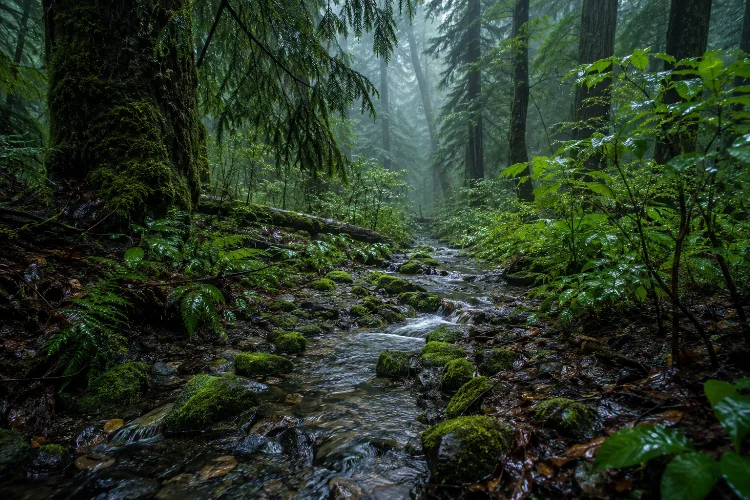
A rainstorm over a forest starts a much more complicated journey than simply sending water straight to the nearest river.
Some raindrops land on leaves and evaporate back into the atmosphere. Others drip down branches, soak into leaf litter, enter the soil, reach tree roots, or move deeper toward groundwater.
Forests are therefore active parts of the water cycle rather than passive landscapes that simply receive rainfall.
Understanding how forests influence the movement and storage of water helps explain why forested watersheds are so important for streams, groundwater, soil moisture, water quality, and downstream communities.
FAO describes forests as major regulators of water quantity, quality, and timing, while forested watersheds provide a large share of freshwater used by people around the world.
However, forests do not simply “create more water.” Trees also consume significant amounts through transpiration.
Their real importance lies in changing where water goes, how quickly it moves, how long it remains in a landscape, and what condition it is in when it reaches streams or aquifers.
Forest Canopies Intercept Rain Before It Reaches the Ground
The first interaction between rainfall and a forest often happens high above the soil.
Leaves, branches, bark, and needles temporarily capture precipitation. This process is called canopy interception.
Some intercepted water eventually drips to the forest floor as throughfall. Another portion runs down trunks as stemflow, while some evaporates directly back into the atmosphere.
The amount intercepted depends on tree species, canopy density, season, storm intensity, and whether precipitation falls as rain or snow.
Forest evapotranspiration research identifies canopy and litter interception as important components of the forest water balance alongside tree transpiration and soil evaporation.
Interception can slow the arrival of water at the soil surface. Instead of all rainfall hitting the ground at once, part of it is temporarily stored in vegetation.
That can be especially useful during smaller storms because it reduces the immediate amount of water moving across the ground.
The Forest Floor Helps Slow and Absorb Water
Once rain passes through the canopy, it often lands on a layer of leaves, needles, twigs, fallen wood, mosses, and decomposing organic matter.
This forest floor acts somewhat like a protective sponge.
It absorbs part of the rainfall and reduces the direct impact of raindrops on mineral soil. Without that protection, heavy rain can break soil particles loose and increase erosion.
FAO notes that forest canopies, understory vegetation, leaf litter, and woody debris reduce rainfall impact while porous forest soils encourage infiltration.
The uneven surface created by roots, litter, logs, and vegetation also slows water moving downhill.
That extra time matters.
Water moving slowly has more opportunity to soak into soil rather than becoming rapid surface runoff.
This is one reason maintaining organic material on the forest floor can be important for watershed management as well as nutrient cycling.
Forest Soils Encourage Water Infiltration
Infiltration happens when water moves from the land surface into soil.
Healthy forest soils often have favorable conditions for this process.
Roots create channels through the ground. Decayed roots leave additional pathways, while insects, worms, and other soil organisms create pores and tunnels.
Organic matter also helps maintain soil structure.
USDA Forest Service research describes many forest soils as having high macroporosity, relatively low bulk density, and high infiltration capacity. As a result, rainfall commonly moves through subsurface pathways rather than flowing immediately over the surface.
USGS also notes that vegetation can slow runoff and give water additional time to infiltrate. Some infiltrated water stays within shallow soil, while another portion moves deeper.
The exact rate of infiltratoin depends on soil texture, slope, saturation, vegetation, rainfall intensity, and previous disturbance.
A compacted forest road, for example, behaves very differently from undisturbed forest soil.
Soil Stores Water for Trees and Other Plants
Not all infiltrated water immediately continues underground.
Some remains within soil pores as soil moisture.
This creates an important temporary water reservoir for vegetation.
Tree roots absorb soil water and use it for photosynthesis, nutrient transport, cellular processes, and cooling through transpiration.
How much water soil can store depends on depth, texture, organic matter, root distribution, and drainage characteristics.
A deep forest soil with good structure may store considerable moisture after rainfall, helping vegetation continue functioning during periods without rain.
This storage function also influences how quickly water moves through a watershed.
Rather than instantly entering a stream, rainfall can spend days, weeks, or longer moving through soil and being taken up by plants.
The forest therefore acts less like a concrete surface and more like a biologically active reservoir.
Some Water Moves Deeper and Recharges Groundwater
Water that travels below the main root zone may continue through soil and rock toward underground aquifers.
This process contributes to groundwater recharge.
USGS explains that precipitation entering the ground can remain in shallow soil, move laterally toward streams, or penetrate deeper into aquifers.
Groundwater may then remain underground for long periods before eventually returning through springs, streams, or other discharge points.
Forests can support this process when soils remain porous and infiltration rates are high.
FAO specifically identifies deep root systems and porous organic-rich forest soils as factors that encourage infiltration and retention.
However, groundwater recharge varies enormously among landscapes.
Climate, geology, slope, soil depth, tree species, and evapotranspiration all influence how much rainfall eventually travels deep enough to become groundwater.
So forests cannot be assumed to increase groundwater everywhere in exactly the same way.
Trees Return Large Amounts of Water to the Atmosphere
Forests store and slow water, but trees are also major water users.
Roots absorb soil moisture and move it upward through xylem to leaves. Water then escapes as vapor through microscopic openings called stomata.
This process is transpiration.
Combined with evaporation from soil, leaves, and intercepted rainfall, it forms evapotranspiration, often shortened to ET.
The USDA Forest Service describes evapotranspiration as the second-largest water flux in forest hydrological cycles after precipitation. Forest ET is often higher than that of other vegetation types under similar climatic conditions.
This is why the idea that “more forest always means more downstream water” is too simple.
FAO notes that forests frequently use more water than replacement land covers such as grassland or agriculture. Removing trees can therefore increase water yield in some circumstances, although it may also reduce water quality, increase erosion, or alter streamflow patterns.
Forests regulate water, but they also actively consume it.
Forests Can Moderate Runoff and Streamflow
When rainfall arrives faster than soil can absorb it, water begins flowing across the surface as runoff.
Healthy forest cover often reduces this rapid movement.
Canopy interception slows rainfall delivery, litter protects the ground, vegetation increases surface roughness, and porous soil encourages infiltration.
USDA Forest Service research finds that surface runoff is relatively uncommon in many undisturbed forest environments because water frequently reaches streams through slower subsurface pathways. These processes can moderate peak flows and prolong baseflow.
FAO similarly notes that forests can produce more consistent streamflow over time compared with many other land covers, although local effects vary with climate, soil, topography, and storm characteristics.
This distinction is important.
Forests cannot prevent every flood, especially during extremely large storms when soils become saturated.
Their strongest hydrological effects often occur during smaller or moderate rainfall events, where storage and infiltration can substantially alter the speed at which water reaches streams.
Forests Help Maintain Water Quality
Water quantity is only one part of forest hydrology.
Quality matters just as much.
Because forest soils encourage infiltration, water often travels through soil rather than rapidly carrying sediment across exposed surfaces.
Roots also stabilize soil, while leaf litter protects it from rainfall impact.
FAO identifies healthy tree cover and understory vegetation as highly effective for reducing erosion and sediment movement into streams. Forest litter and vegetation can also help filter some pollutants.
USDA Forest Service research similarly links forest soils with high-quality water supplies because subsurface flow allows nutrient uptake, cycling, and contaminant sorption to occur before water reaches streams.
This is why many communities depend on forested watersheds for drinking-water sources.
The hydrological value of a forest is therefore not simply how many liters of water leave it.
It is also the quality and timing of that water.
Roads and Soil Compaction Can Change Forest Hydrology
A forested watershed can still develop water problems if its soils are heavily disturbed.
Roads are a good example.
Compacted road surfaces often absorb far less rainfall than natural forest soil. Water instead runs along or across the road, potentially carrying sediment into streams.
USDA research on forest roads found extremely low hydraulic conductivity on compacted road surfaces compared with treated or undisturbed areas. Even after restoration work, infiltration did not always return completely to natural forest conditions.
This demonstrates why sustainable forestry needs to consider roads, skid trails, landings, and heavy machinery.
Maintaining soil structure protects water availablity as well as tree growth.
Good watershed management often involves limiting unnecessary soil compaction, designing drainage carefully, protecting riparian areas, and minimizing exposed soil.
The health of forest water systems depends on what happens below the canopy as much as what happens above it.
Deforestation Changes the Way Water Moves
Removing forest cover alters several parts of the water cycle at once.
There is less canopy interception and generally less transpiration. Soil may become more exposed to rainfall, while roads, agriculture, grazing, or development can compact the ground.
The result depends heavily on what replaces the forest.
FAO warns that watershed degradation associated with deforestation, uncontrolled harvesting, roads, overgrazing, and other land-use changes can increase runoff and erosion, reduce groundwater infiltration, increase sedimentation, and degrade water quality.
Yet forest loss may simultaneously increase total stream water yield because fewer trees are using water through evapotranspiration.
This apparent contradiction makes sense once we separate quantity from regulation.
More water flowing out of a watershed does not automatically mean the watershed is healthier.
If that water arrives rapidly during storms, carries sediment, and leaves little stored for later dry periods, the increased yield may come with major ecological costs.
Forest Hydrology Depends on Climate and Location
There is no single forest-water relationship that applies everywhere.
A tropical rainforest, boreal forest, dry woodland, cloud forest, and temperate mountain forest operate under very different climatic conditions.
Tree species matter too.
Some forests have high evapotranspiration rates, while others store large quantities of snow before spring melt.
Soil depth, geology, topography, rainfall seasonality, and atmospheric demand all influence where water goes.
FAO therefore recommends evaluating forest-water relationships at appropriate landscape and watershed scales rather than assuming that one management strategy works in every enviroment.
This is especially important under climate change.
Shifts in temperature and rainfall can alter evapotranspiration, soil moisture, fire, groundwater recharge, and streamflow.
Forest management increasingly needs to consider water as a dynamic resource rather than a fixed background condition.
Why Forest-Water Relationships Matter for Management
Foresters managing watersheds need to think about much more than trees.
Maintaining canopy cover, protecting streamside vegetation, reducing road erosion, retaining soil organic matter, avoiding excessive compaction, and planning harvest operations carefully can all influence hydrological performance.
FAO estimates that forested watersheds supply a major share of the world’s accessible freshwater, making forest-water management relevant far beyond forest boundaries.
Decisions made uphill can influence communities, farms, reservoirs, aquatic habitats, and drinking-water systems downstream.
That is why watershed management treats land and water as connected systems.
A well-managed forest can store water temporarily, slow its movement, support infiltration, help recharge groundwater, filter runoff, and release water toward streams through a mixture of surface and subsurface pathways.
At the same time, trees return large quantities of water to the atmosphere.
Understanding both sides of that balance leads to better forest management decisions.
Forests influence almost every stage of water’s journey across the landscape.
Their canopies intercept rainfall, litter slows water at the surface, porous soils encourage infiltration, and root zones temporarily store moisture. Some water moves deeper into groundwater, while some travels slowly toward streams.
Trees also return substantial amounts of water to the atmosphere through evapotranspiration, which means forests regulate water rather than simply increasing its supply.
Healthy forest hydrology depends on vegetation, soil, climate, terrain, and responsible management working together. When evaluating a forest, look beyond the trees themselves.
Consider the litter, soil pores, roots, streams, slopes, and groundwater underneath them. Protecting those connections can help maintain cleaner water, more stable watersheds, and healthier forest ecosystems for the future.