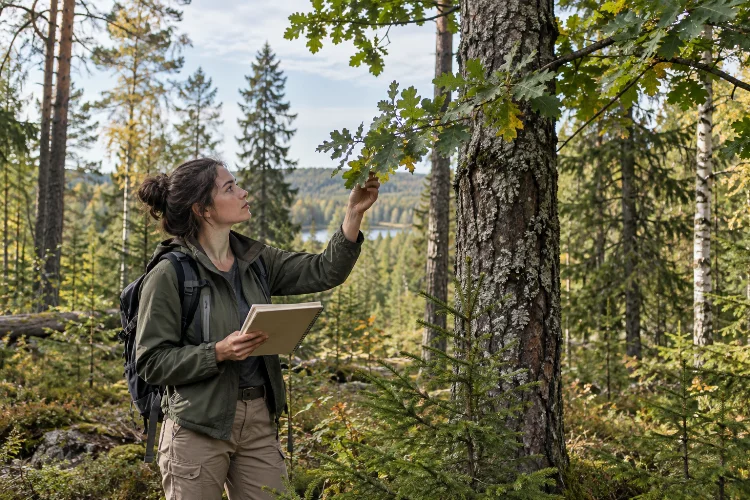
Walk into a forest with an experienced forester and you may notice something interesting. While most people see a collection of trees, the forester sees different species, crown positions, bark patterns, growth rates, regeneration potential, and clues about the site itself.
Learning to notice those details is an essential part of forestry education.
The important tree characteristics every forestry student should learn go far beyond simply knowing a tree’s common name.
Students need to understand how trees can be identified, how they grow, why certain species dominate particular environments, and what their physical features can reveal about forest health.
Leaves, bark, buds, roots, flowers, fruit, crown structure, and wood anatomy all provide useful information. Even characteristics such as shade tolerance and growth habit can influence how a tree responds to competition and forest management.
Mississippi State University Extension recommends examining multiple features – including leaves, twigs, flowers, fruit, bark, overall form, and growing site – when identifying trees.
For forestry students, learning these clues turns an ordinary forest walk into a practical field lesson.
1. Overall Tree Form and Crown Shape
Before examining a leaf, take a few steps back and look at the entire tree.
The overall form can provide valuable information about species, age, competition, and growing conditions. Tree crowns may be pyramidal, oval, rounded, broad, columnar, irregular, or shaped in other recognizable ways.
A tree growing alone in an open field may develop a broad crown because sunlight reaches it from several directions. The same species inside a dense forest might grow a narrower crown as it competes with neighboring trees.
Crown condition also tells foresters something about health.
The USDA Forest Service uses measurements such as crown density, live crown ratio, foliage transparency, and crown dieback when assessing forest condition. Trees with fuller, vigorous crowns are generally associated with stronger growth, while major dieback can indicate stress.
For students, the lesson is simple: do not look only at the trunk. The crown can tell an important part of the story.
2. Leaves Are Some of the Best Identification Tools
Leaves are usually among the first characteristics forestry students learn because they provide several clues at once.
Start by determining whether the tree has broad leaves, needles, or scale-like foliage. Then look at whether each leaf is simple or compound.
Leaf arrangement matters too.
Leaves may grow alternately along a twig, directly opposite one another, or occasionally in whorls. Their margins may be smooth, toothed, serrated, or lobed.
Shape, venation, texture, color, and even the underside of a leaf can help narrow down an identification.
The Utah State University botanical glossary includes terms for characteristics such as lobed margins, serrated edges, needle-like leaves, leaflets, nodes, and other features commonly used in forestry identification.
One common beginner mistake is studying only one leaf. Leaves can vary within the same tree, so examining several mature specimens usually gives a more reliable picture.
3. Bark Becomes More Useful With Practice
At first, bark may seem like nothing more than different shades of gray and brown.
Spend enough time in the forest, however, and the differences become much more obvious.
Some species have smooth bark when young and deeply furrowed bark when mature. Others develop flakes, plates, scales, horizontal markings, or distinctive peeling patterns.
Quaking aspen, for example, typically has relatively smooth, pale bark when young, while older trunks can become furrowed. Douglas-fir also changes noticeably with age, developing rougher and thicker bark as the tree matures.
Bark is particularly useful when deciduous trees have lost their leaves.
However, students should avoid identifying a species from bark alone. Age, environmental conditions, injuries, and disease can alter bark appearance.
Treat bark as one piece of evidence rather than the entire answer.
4. Twigs and Buds Matter More Than Beginners Expect
Twigs and buds are easy to ignore during summer because leaves attract most of the attention.
During winter, they can become some of your best clues.
Buds vary in shape, size, color, texture, position, and arrangement. Some species have obvious terminal buds at the end of the twig, while others do not.
Lateral buds occur along twigs where previous leaves were attached. Leaf scars and the arrangement of buds can also reveal whether a species has opposite or alternate branching.
Twigs may be smooth, hairy, aromatic, thick, slender, or covered with distinctive markings.
Learning these charateristics is especially useful in temperate forests where deciduous trees can remain leafless for months.
The USDA Forest Service has long used leaves, bark, buds, flowers, fruits, and winter silhouettes together in tree identification guides, demonstrating why field identification works best when several traits are combined.
5. Flowers, Fruit, Seeds, and Cones Reveal Reproductive Traits
Trees reproduce in many different ways, and their reproductive structures can be highly distinctive.
Flowers may be large and colorful, but many forest trees produce small, easily overlooked flowers. Some appear in clusters, while others form catkins or other specialized structures.
Fruit is often easier to notice.
Oaks produce acorns, maples commonly produce winged samaras, and many conifers form cones. Other species develop pods, capsules, berries, or nuts.
These structures are useful for more than identification.
Forestry students need to understand reproduction because seed production affects natural regeneration.
A forest manager trying to establish the next generation of trees needs to know when a species produces seeds, how those seeds disperse, and what conditions allow seedlings to establish.
A mature tree without successful regeneration beneath it may eventually disappear from that stand even if the adult itself looks healthy.
6. Roots Influence Stability, Water, and Nutrient Uptake
Most tree identification lessons focus on features above ground, but foresters cannot ignore roots.
Roots anchor trees while absorbing water and mineral nutrients. They also interact with soil organisms and influence the movement and structure of soil around them.
Different species and sites can produce different rooting patterns.
Soil depth, drainage, oxygen availability, compaction, and obstacles can strongly influence where roots develop. A tree growing in shallow or waterlogged soil may develop a very different root system from one growing in deep, well-drained soil.
Below-ground space can be just as important as crown space above ground. Utah State University Extension notes that sufficient rooting area is an important consideration for healthy tree development.
For forestry students, roots help explain why trees that appear healthy above ground may become unstable or stressed when soil conditions deteriorate.
7. Growth Rate and Longevity Affect Forest Development
Not all tree species grow at the same speed.
Some establish rapidly and reach substantial heights relatively early. Others grow slowly but may persist for much longer periods.
These differences influence forest succession and management.
Fast-growing species may quickly occupy open areas after disturbance. Slower-growing, shade-tolerant species may survive beneath an existing canopy and gradually become more important as conditions change.
Foresters therefore need to understand growth rate together with expected mature size and longevity.
Utah State University’s TreeBrowser, for example, organizes species using characteristics that include growth rate, mature height, longevity, crown shape, shade tolerance, drought tolerance, and drainage tolerance.
These characteristics help explain not only what a tree looks like today but how it may behave over decades of forest developement.
8. Shade Tolerance Explains Competition Inside a Forest
Shade tolerance is one of the most useful ecological characteristics for forestry students to understand.
Some tree species require abundant sunlight, especially when young. Others can survive for years beneath a forest canopy with relatively little light.
This difference strongly influences succession.
When a canopy gap forms after a storm, harvest, or tree death, light-demanding seedlings may suddenly grow rapidly. Shade-tolerant species, meanwhile, may already be waiting beneath the canopy.
Douglas-fir is described as having intermediate shade tolerance, while species such as Engelmann spruce can tolerate considerable shade and are associated with cool, moist sites.
Understanding shade response helps foresters choose thinning methods, regeneration systems, and canopy treatments.
It also explains why opening a forest canopy can favor some species while putting others at a disadvantage.
9. Wood Characteristics Matter in Forestry
Tree species also differ internally.
Wood can vary in density, strength, grain, color, durability, pore arrangement, and other anatomical features.
Hardwoods typically contain vessels that transport water, while conifer wood relies primarily on tracheids for water conduction.
These differences can influence how wood is used.
Some species produce strong structural timber. Others are better suited for pulp, furniture, veneer, fuelwood, boxes, poles, or specialized products.
Wood characteristics can also help identify species when leaves and bark are unavailable.
For forestry students interested in forest products, understanding wood anatomy connects tree biology with practical decisions about harvesting, processing, and utilization.
10. Site Requirements Explain Where Trees Grow
Knowing what a species looks like is useful. Knowing why it grows where it does is even more valuable.
Tree species differ in their tolerance of drought, flooding, cold, heat, poor drainage, soil chemistry, elevation, and shade.
Engelmann spruce, for example, is associated with cooler, moist environments, while other species perform better under warmer or drier conditions.
This relationship between species and habitat helps students interpret an entire landscape.
Finding certain trees may suggest something about soil moisture, elevation, disturbance history, or microclimate.
Site knowledge is also essential in forest management. Planting or encouraging a species outside suitable conditions can lead to slow growth, poor health, or mortality.
A good forester therefore studies the tree and its enviroment together.
Why Forestry Students Should Combine Multiple Characteristics
The most reliable approach is never to depend on a single trait.
A leaf may resemble several species. Bark can change as a tree ages. Flowers and fruit may be absent during much of the year.
Instead, combine clues.
Look at overall form, crown condition, leaves, buds, bark, reproductive structures, habitat, and geographic occurence. If several independent characteristics point toward the same species, your identification becomes much more reliable.
The same habit improves forest management decisions.
Foresters rarely make decisions from one measurement alone. They combine species biology, tree condition, competition, soil, climate, regeneration, stand structure, and management objectives.
Learning tree characteristics is therefore more than an identification exercise. It teaches forestry students how to observe forests systematically.
Understanding tree characteristics gives forestry students a foundation for nearly everything that comes later in their studies.
Leaves, bark, buds, flowers, fruit, roots, crown form, wood, growth rate, longevity, and shade tolerance all provide information about how a tree lives and responds to its surroundings.
Site requirements add another layer by explaining why certain species occur in particular environments.
The key is to connect these traits rather than memorize them separately. The next time you enter a forest, choose one tree and study it from top to bottom.
Look at the crown, examine several leaves, touch the bark, inspect the twigs, search for fruit, and consider the site. Repeating that process regularly is one of the simplest ways to turn textbook forestry knowledge into real field skills.