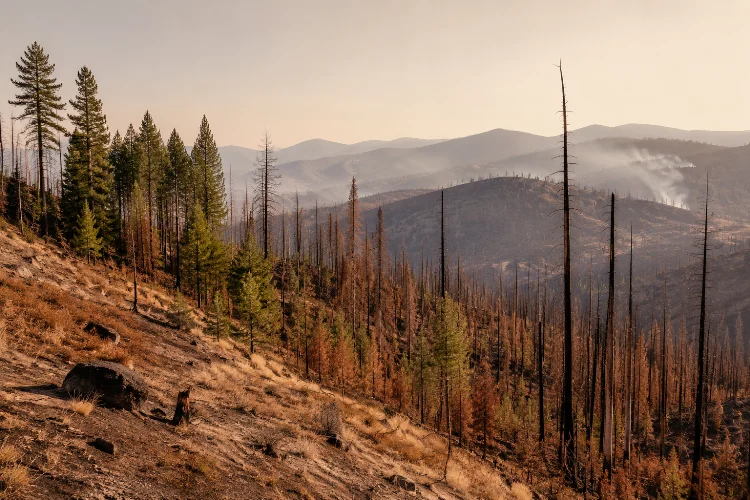
Forests have always dealt with change. Droughts come and go, fires reshape landscapes, insects attack trees, and species gradually move as environmental conditions shift.
What is different today is the speed and scale at which many of these pressures are changing.
Climate change is altering forest ecosystems around the world through rising temperatures, changing rainfall patterns, longer droughts, extreme heat, wildfire, pest outbreaks, and shifts in suitable habitat. These pressures often interact rather than happening separately.
The IPCC reports that human-caused climate change has already contributed to increases in wildfire, drought-related tree mortality, pest damage, and vegetation shifts across tropical, temperate, and boreal ecosystems.
At the same time, forests are major climate regulators because they store enormous amounts of carbon in vegetation, deadwood, and soil. FAO’s latest global assessment reports that forests still cover about 4.14 billion hectares, roughly one-third of Earth’s land area.
Understanding these changes matters because forest decline affects far more than trees. It influences biodiversity, water, carbon storage, livelihoods, and the stability of entire landscapes.
Rising Temperatures Are Increasing Tree Stress
Temperature is one of the strongest controls on tree growth.
Moderate warming can sometimes benefit forests in cold regions by extending the growing season. But once temperatures move beyond a species’ comfortable range, the effects can quickly become negative.
Hotter conditions increase evaporation from soil and water loss from leaves. Trees must pull water through their roots and xylem more aggressively, increasing hydraulic stress.
When water becomes limited, trees often close their stomata to reduce moisture loss. That response saves water but also restricts the carbon dioxide needed for photosynthesis.
Growth consequently slows.
FAO notes that increased temperatures can relieve cold stress in some locations but increase heat and moisture stress elsewhere, contributing to changes in forest productivity, dieback, and ecosystem composition.
The problem becomes especially serious when high temperatures occur together with drought.
Drought Is Driving Tree Mortality in Many Regions
Climate-driven forest drought involves more than simply receiving less rain.
Hotter air increases atmospheric demand for moisture, meaning trees can lose water faster even when rainfall changes only moderately.
Prolonged water stress can eventually damage a tree’s hydraulic system. If the water column inside xylem breaks down, branches or entire trees may die.
The IPCC has documented climate-related drought mortality across forests on several continents.
It reports that human-caused climate change has contributed to more than 100 observed cases of drought-related tree mortality around the world, alongside major mortality events in parts of Africa and North America.
Large trees can be particularly vulnerable during severe droughts because their long hydraulic pathways make water transport challenging.
Seedlings face another problem.
Their shallow roots often cannot reach deeper moisture reserves, so extended dry periods can dramatically reduce forest regneration even where mature trees initially survive.
That means drought can alter not only today’s forest but also the next generation.
Wildfires Are Becoming a Bigger Forest Threat
Fire is natural and even necessary in many forest ecosystems.
Some pine forests, savannas, and boreal landscapes evolved with periodic burning. Fire can recycle nutrients, create habitat, and open growing space for new vegetation.
Climate change becomes a problem when fire behavior moves outside the historical conditions to which an ecosystem is adapted.
Hotter temperatures, prolonged drought, and dry vegetation can lengthen fire seasons and increase the likelihood of extreme fires.
The IPCC reports that fire seasons have lengthened across roughly one-quarter of vegetated land since 1979 due to rising temperature, aridity, and drought.
Recent data demonstrate how significant the problem can become. WRI reported that global tree-cover loss reached a record level in 2024, with fires playing an unusually large role across both tropical and boreal regions.
Hot, dry conditions associated with climate change and El Niño helped intensify fire conditions that year.
Repeated severe fires can prevent trees from reaching reproductive age, making recovery increasingly difficult.
Pests and Diseases Are Expanding Into New Areas
Trees are also facing biological threats influenced by climate.
Insects and pathogens depend heavily on temperature and moisture. Warmer winters may allow some insects to survive in areas where cold weather once kept their populations low.
Longer warm seasons can sometimes accelerate reproduction or allow pests to expand into higher elevations and latitudes.
Trees weakened by drought can also become less capable of defending themselves.
FAO reports that climate change can alter forest pests through changes in their survival, reproduction, distribution, development, and interactions with host trees.
Recent USDA Forest Service research using two decades of North American data similarly found evidence that warming temperatures and changing precipitation patterns may increase damage from major forest pests.
Pests rarely act alone.
Drought may weaken trees, insects may then attack them, and dead vegetation can change fuel conditions for future fires. These interacting disturbances can produce much larger effects than any single stressor.
Tree Species Are Shifting Their Geographic Ranges
Every tree species has a climatic niche.
Temperature, rainfall, winter cold, soil moisture, and seasonal patterns all help determine where a species can successfully grow and reproduce.
As those conditions shift, suitable habitat moves as well.
Some tree populations are already moving toward higher elevations or cooler latitudes. Others are declining near the warmer or drier edges of their existing ranges.
The IPCC reports documented biome shifts of up to about 20 kilometers in latitude and 300 meters upslope in some terrestrial ecosystems associated with human-caused climate change.
Tropical forests are changing too.
The IPCC finds high-confidence evidence that warming, drought, and fire are altering tropical forest structure and species composition, including movement of species toward higher elevations and increasing risk of transitions toward drier vegetation in parts of the Amazon.
Trees cannot migrate quickly, of course.
Their movement depends on seeds successfully dispersing, germinating, and reaching reproductive maturity in newly suitable areas. Fragmented landscapes can make that process much harder.
Forest Biodiversity Is Being Reshaped
When tree species change, many other organisms change with them.
Birds may depend on particular fruits or nesting trees. Insects may rely on specific host plants. Fungi form relationships with certain roots, while mammals help disperse seeds.
Climate-driven shifts in tree communities can therefore spread through entire ecological networks.
Some species may benefit temporarily from warmer conditions, while others lose suitable habitat.
The result is not necessarily the disappearance of forest cover.
A landscape may remain covered in trees while becoming biologically very different from the forest that existed there several decades earlier.
Climate change can also favor invasive species, pests, or competitors that respond more quickly than slower-growing native trees.
This is why forest resiliance depends partly on maintaining species diversity, genetic variation, habitat connectivity, and multiple age classes.
Greater ecological variety gives forests more possible ways to respond when environmental conditions change.
Climate Change Can Weaken the Forest Carbon Sink
Forests help slow global warming by removing carbon dioxide from the atmosphere through photosynthesis.
That carbon becomes stored in trunks, roots, leaves, soil, and dead organic material.
But this climate service is not guaranteed.
Drought, fires, tree mortality, deforestation, and decomposition can release stored carbon back into the atmosphere.
The IPCC has found that ongoing climate change has already weakened the carbon-sink potential of tropical forests in regions including Amazonia.
Recent WRI analysis found an especially sharp decline during 2023 and 2024. Extreme fires caused forests to absorb far less carbon than usual, with global forest carbon removals during those two years estimated at only about one-quarter of an average year’s level.
This creates a dangerous feedback.
Climate change can increase drought and fire. Those disturbances kill or burn trees, releasing more greenhouse gases and reducing future carbon uptake.
That additional carbon can then contribute to further warming.
Water Cycles Are Changing Along With Forests
Forest climate impacts extend into rivers, groundwater, and rainfall.
Trees intercept precipitation, absorb soil water, release moisture through transpiration, and influence how quickly water moves through a watershed.
When forests experience extensive mortality or fire, those processes can change.
Loss of canopy cover may alter snow accumulation, soil temperature, runoff, erosion, stream temperature, and evapotranspiration.
The IPCC concludes that excessive tree mortality degrades not only habitat and carbon storage but can also reduce water supplies and other ecosystem services.
These effects differ greatly between regions.
A boreal forest dependent on snowpack faces different challenges from a tropical rainforest dependent on frequent rainfall.
That is why climate adaptation needs to consider the entire forest enviroment, including soil, water, topography, vegetation, and surrounding land use.
Forest Recovery Is Becoming Less Predictable
Forests have recovered from disturbance for millions of years.
The concern is that future conditions may no longer support the species that dominated before a disturbance occurred.
Imagine a conifer forest destroyed by severe wildfire.
Historically, seedlings might have recolonized the site and gradually rebuilt a similar forest. But if summers have become much hotter and drier, seedlings may repeatedly fail.
Shrubs, grasses, or drought-tolerant tree species may take their place.
This is known as an ecosystem or vegetation transition.
The IPCC reports that climate change and wildfire have already reduced natural regeneration and altered vegetation composition in some regions.
In tropical forests, repeated combinations of drought, heat, fragmentation, and fire can similarly make recovery harder.
Forest restoration therefore cannot simply recreate historical conditions without considering the future climate.
Forest Management Is Shifting Toward Climate Adaptation
Foresters cannot control global temperature or rainfall at the stand level, but management can sometimes reduce vulnerability.
Maintaining a mixture of tree species can spread risk.
Thinning overly dense stands may reduce competition for limited water in drought-prone forests. Protecting genetic diversity preserves traits that may help future generations adapt.
Habitat corridors can make it easier for plants and wildlife to shift across landscapes.
Managers may also protect climate refugia-areas where local topography or moisture creates cooler conditions-and choose restoration seed sources with future climate suitability in mind.
FAO emphasizes the need for proactive, integrated forest risk management as wildfire, drought, storms, pests, and disease increasingly interact.
Climate-smart forestry is therefore less about predicting one perfect future and more about keeping ecological options open.
Climate change is reshaping forests through rising temperatures, drought, wildfire, pests, shifting species distributions, changing water cycles, and increasing tree mortality.
These pressures interact, making future forest conditions less predictable than simple warming alone would suggest.
Forests remain powerful carbon stores and essential habitats, but their ability to provide those benefits depends on maintaining healthy and adaptable ecosystems.
The most effective response combines climate mitigation with practical forest adaptation: protecting existing forests, reducing fragmentation, maintaining biodiversity, supporting natural regeneration, restoring degraded landscapes, and monitoring change over time.
As climate conditions continue to shift, the goal should not be to freeze forests in their current state. It should be to give them enough ecological diversity and flexibility to keep functioning in the decades ahead.