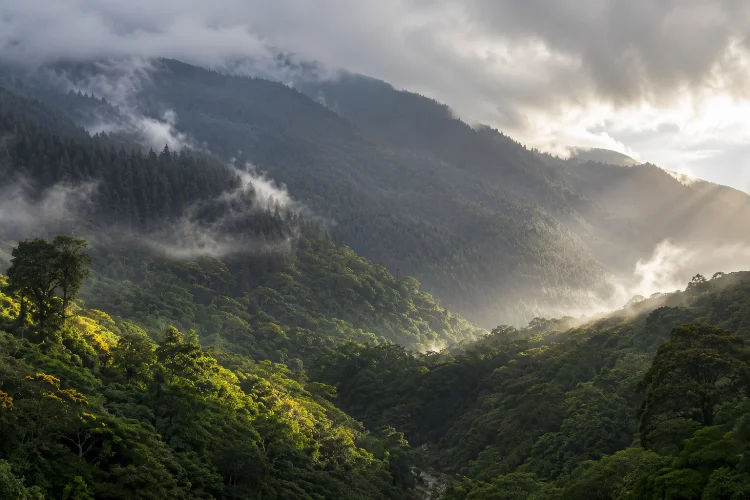
Why does a tropical rainforest look completely different from a boreal forest, even though both are dominated by trees? A large part of the answer comes down to two basic climate factors: temperature and rainfall.
Together, they influence how quickly trees grow, which species can survive, how long the growing season lasts, how much water remains in the soil, and how often forests experience drought, fire, or other disturbances.
Even relatively small changes in seasonal temperature or precipitation can gradually reshape a forest community. Understanding how temperature and rainfall shape forest ecosystems is especially important because trees are long-lived organisms.
A forest growing today reflects climate conditions from many years in the past while also responding to current weather and emerging climate trends.
The National Park Service describes air temperature and precipitation as major drivers of ecological processes because they affect forest productivity, plant growth, streamflow, snowpack, and disturbance events.
Climate does not act alone, but it provides the environmental boundaries within which forests develop.
Temperature Controls the Pace of Forest Life
Temperature influences nearly every biological process inside a forest.
Trees rely on chemical reactions for photosynthesis, respiration, nutrient uptake, and growth. These processes generally speed up as temperatures rise within a species’ suitable range.
In colder climates, low temperatures can restrict the length of the growing season. Trees may remain dormant through winter and begin active growth only after spring conditions become warm enough.
This helps explain why forests near high elevations or northern latitudes often grow more slowly than forests in warmer regions.
However, warmer conditions are not always beneficial.
FAO notes that rising temperatures can improve growth where cold is currently limiting, but excessive heat can increase plant stress and contribute to changes in forest productivity, health, and species distribution.
Every tree species therefore has a temperature range in which it performs best.
Rainfall Determines How Much Water Trees Can Access
Trees require enormous amounts of water throughout their lives.
Roots absorb moisture from soil, and that water travels upward through xylem before much of it eventually returns to the atmosphere through transpiration.
Rainfall helps replenish this supply.
In consistently wet forests, soil moisture may remain available through much of the year. In seasonal forests, trees often experience alternating wet and dry periods.
The amount of annual precipitation matters, but timing can be just as important.
A forest receiving most of its rainfall during a short rainy season may function very differently from one receiving the same annual total spread evenly across twelve months.
USDA Forest Service research emphasizes that precipitation directly affects soil moisture and water balances, while temperature influences atmospheric drying demand and tree stress.
This interaction means rainfall cannot be understood separately from temperature.
A moderate drop in precipitation may have relatively small effects during cool weather but become much more serious during an unusually hot year.
Temperature and Rainfall Help Determine Where Forest Types Occur
Different forests occupy different climate zones because tree species have distinct environmental tolerances.
Tropical rainforests generally develop in warm areas with high moisture availability. Temperate forests experience stronger seasonal changes, while boreal forests survive long, cold winters and relatively short growing seasons.
Dry forests occur where rainfall is more seasonal or limited.
Climate therefore helps shape global forest distribtuion.
Research using U.S. forest inventory data found that temperature and precipitation patterns are strongly linked with forest community tolerances and geographic distributions.
Elevation creates similar patterns on a smaller scale.
As you travel up a mountain, average temperatures generally decline. Precipitation patterns may also change, sometimes increasing with elevation before declining at very high locations.
The National Park Service describes these gradients in southwestern mountain forests, where elevation influences temperature, growing-season length, snowpack, and vegetation patterns.
In effect, walking up a mountain can sometimes resemble traveling toward a colder climate zone.
Climate Influences Tree Growth and Forest Productivity
Forest productivity refers to how quickly vegetation produces new biomass, including leaves, roots, branches, and wood.
Both temperature and water availability influence that process.
Where temperatures are very low, warming may extend the growing season and allow trees to photosynthesize for longer periods.
But in warmer environments, additional heat can increase water loss and reduce growth.
Research in forests of the northern Great Lakes found that climatic variables explained a substantial proportion of annual tree-growth variation, although responses differed between species and locations.
This is an important point.
There is no simple rule that says more rain always produces faster growth or that warmer temperatures always increase productivity.
Trees can be limited by several factors at once, including nutrients, light, soil conditions, competition, and water availablity.
Climate changes which limitation becomes most important.
Seasonal Rainfall Shapes Forest Behavior
Annual rainfall totals can hide important ecological differences.
Imagine two forests that each receive 1,500 millimeters of precipitation per year.
One receives regular rain almost every month. The other gets nearly all its water during a six-month rainy season followed by a long dry period.
Those forests may develop completely different species and survival strategies.
Some trees in seasonal forests drop their leaves during dry months to reduce water loss. Others develop deep roots, thick bark, or physiological mechanisms that help them tolerate drought.
Seasonality also affects seed germination and reproduction.
Many tree species time flowering, fruit production, seed dispersal, or germination around predictable wet and dry seasons.
Climate therefore acts like an ecological calendar.
When rainfall timing shifts, plants may experience favorable temperatures but insufficient moisture-or abundant rainfall at the wrong stage of their life cycle.
Hotter Conditions Can Make Drought More Severe
Drought is not simply a lack of rainfall.
Temperature matters too.
Warm air can create greater atmospheric demand for water. Trees may lose moisture more rapidly through transpiration while soil dries faster.
USDA Forest Service research explains that warmer droughts can increase vapor pressure deficit, creating stronger water-pressure gradients inside trees and raising the risk of hydraulic stress or failure.
Trees often respond by closing their stomata.
This reduces water loss but also limits carbon dioxide entering the leaves, which decreases photosynthesis.
If drought continues, tree growth may slow significantly. Severe or repeated drought can contribute to crown dieback, mortality, and increased vulnerability to insects or pathogens.
Research reviews also show that drought can alter forest structure, species composition, regeneration, and long-term ecosystem dynamics.
A hotter climate can therefore make the same amount of missing rainfall more stressful than it would have been under cooler conditions.
Temperature and Rainfall Affect Wildfire Risk
Climate also influences how likely forests are to burn.
Extended dry periods reduce moisture in grasses, leaves, dead branches, and other fuels.
High temperatures can dry this material even faster.
When ignition occurs, dry vegetation can support faster or more intense fire depending on fuel quantity, wind, terrain, and ecosystem type.
The relationship is not identical everywhere because some forests naturally evolved with frequent fire while others burn relatively rarely.
Still, changing temperature and precipitation patterns can alter fire seasons and disturbance regimes.
A USDA Forest Service climate synthesis identifies wildfire, drought-induced mortality, insects, flooding, and other disturbances among some of the most visible ways climatic changes can reshape forest ecosystems.
Fire can then reinforce ecological change.
If mature trees die and regeneration conditions change, new species may replace those that previously dominated.
Climate Shapes Forest Biodiversity
Forest biodiversity is partly determined by which species can tolerate local climate conditions.
Trees adapted to cool, moist conditions may compete poorly as environments become hotter or drier.
Other species may expand into newly suitable areas.
Animals, fungi, and microbes respond too.
Changing rainfall can affect fruit production, flowering, decomposition, insects, soil organisms, and water availability for wildlife.
This means climate-driven changes in one group can spread through the wider food web.
FAO reports that changes in temperature, rainfall, and extreme weather influence forest productivity, habitat suitability, health, and the risk of pests and fire.
Forests may therefore gradually shift in species composition even if the land remains covered by trees.
A forest can stay green while becoming ecologically very different.
Snowfall Matters in Cold Forests
Precipitation does not always arrive as rain.
In mountain and northern forests, snow can function as a seasonal water-storage system.
Snow accumulates during winter and slowly releases water as temperatures rise in spring.
This meltwater can support soil moisture and streamflow well into the growing season.
Warmer temperatures can reduce the amount of precipitation falling as snow and cause earlier snowmelt.
USDA Forest Service scientists note that reduced snowpack storage can decrease summer water availability in some forested regions.
That creates an interesting situation: annual precipitation might remain similar while the timing of usable water changes dramatically.
Trees that once depended on gradual spring and summer moisture may experience longer dry periods later in the year.
Forests Also Modify Their Own Local Climate
Climate shapes forests, but forests also modify climatic conditions around them.
Canopies provide shade that reduces direct solar heating near the forest floor.
Transpiration releases water vapor into the atmosphere, while vegetation affects humidity, surface temperature, and water cycling.
A recent FAO synthesis highlights the role of forests and trees in influencing temperature, rainfall patterns, water availability, and broader landscape climate processes.
This creates feedback between forests and climate.
Removing extensive forest cover can change surface temperatures and water movement, while maintaining or restoring forests can influence local and regional environmental conditions.
These effects vary considerably with location and forest type, so forests should not be treated as identical climate-control systems.
Still, the relationship clearly works in both directions.
Climate Change Can Push Forests Beyond Familiar Conditions
Trees can tolerate natural climate variation, but rapid long-term changes create a different challenge.
Many trees live for decades or centuries, meaning individuals established under one climate may experience very different conditions later in life.
FAO warns that changes in temperature, precipitation, and extreme events can affect forest productivity, health, habitat suitability, fire risk, and pest activity. In some cases, climatic changes may exceed the natural adaptive capacity of forest species.
Forests can respond through migration, natural selection, species replacement, regeneration changes, or mortality.
But these processes take time.
Fragmented landscapes can make migration particularly difficult because seeds may not easily reach newly suitable habitats.
Forest managers are therefore increasingly considering climate projections when selecting restoration species, managing stand density, protecting genetic diversity, and planning future forests.
The goal is not to predict the future perfectly.
It is to maintain enough ecological resiliance for forests to respond when conditions change.
Temperature and rainfall are two of the strongest environmental forces shaping forest ecosystems. They influence tree growth, water supply, growing seasons, species distribution, productivity, regeneration, snowpack, drought, fire, and biodiversity.
Their effects also interact. High temperatures can make rainfall shortages more stressful, while seasonal precipitation patterns may matter as much as annual totals.
Different tree species respond in different ways, which is why climatic change can gradually alter entire forest communities. When studying a forest, look beyond the trees and consider its climate story.
Ask when rain falls, how hot summers become, how long snow remains, and whether droughts are becoming more frequent. Understanding those patterns provides valuable clues about why a forest looks the way it does today-and how it may change in the future.