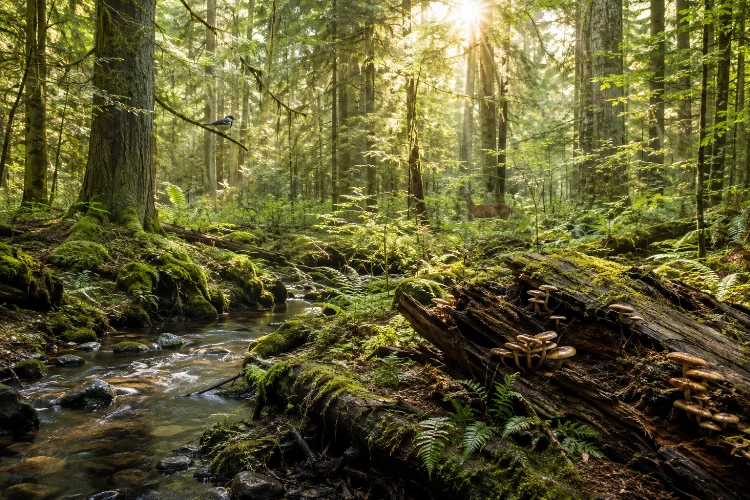
A forest may look peaceful from the outside, but underneath that quiet green canopy, thousands of biological and physical processes are happening at the same time.
Trees compete for sunlight, fungi exchange nutrients with plant roots, insects break down organic material, animals move seeds, and microorganisms recycle dead matter back into the soil.
Understanding how forest ecosystems function and change over time means looking beyond individual trees. A forest is a connected ecological system in which plants, animals, fungi, microorganisms, soil, water, sunlight, and climate constantly interact.
These systems are also never completely static. Fires, storms, droughts, insects, human activities, and climate shifts can gradually-or suddenly-reshape them.
After disturbance, forests may recover through ecological succession, sometimes returning to a familiar structure and sometimes developing in a completely different direction.
That dynamic nature is what makes forest ecology so interesting. A healthy forest is not simply one that never changes. In many cases, change itself is essential to keeping the ecosystem productive, diverse, and resilient.
What Makes a Forest an Ecosystem?
A forest ecosystem includes both living organisms and the nonliving environment around them. Trees may be the most visible organisms, but they represent only one part of a much larger ecological network.
The living components include shrubs, grasses, mosses, mammals, birds, reptiles, insects, fungi, bacteria, and countless microorganisms. The nonliving components include sunlight, temperature, rainfall, soil minerals, water, air, and topography.
These elements constantly influence one another. Soil conditions affect which trees can survive, while trees change the soil by dropping leaves, creating shade, absorbing water, and adding organic matter.
Forest structure also matters. Many forests contain several vertical layers, including the canopy, understory, shrub layer, forest floor, and underground root zone. Each layer creates different habitats and environmental conditions.
This complexity helps explain why forests contain such extraordinary biodiversity. FAO reports that forests cover about 31% of the world’s land surface and support much of Earth’s terrestrial biodiversity.
Energy Flow Starts With Sunlight
Like most ecosystems, forests ultimately run on solar energy.
Trees and other green plants capture sunlight through photosynthesis. They use that energy to convert carbon dioxide and water into carbohydrates that support growth, reproduction, and maintenance.
Because plants produce their own biological energy, ecologists call them primary producers. That stored energy then moves through the food web.
A caterpillar may eat a leaf. A bird may eat the caterpillar. A hawk may later prey on the bird. Eventually, all of these organisms die and become food for decomposers.
However, energy does not cycle endlessly. Some is lost as heat at every stage of the food chain. This means forests require a continuous supply of energy from the sun.
The amount of sunlight available also shapes forest structure. Large canopy trees capture much of it, while shade-tolerant plants have adapted to survive with far less light underneath.
Nutrient Cycling Keeps the Forest Productive
Energy flows through forests, but nutrients are repeatedly recycled.
Leaves, branches, animal waste, dead roots, and fallen trees eventually reach the forest floor. Fungi, bacteria, insects, worms, and other decomposers slowly break this organic material apart.
During decomposition, important nutrents such as nitrogen, phosphorus, potassium, and calcium become available again. Plants absorb them through their roots, use them to grow, and eventually return them to the soil when plant material dies.
This creates what ecologists call a biogeochemical cycle.
Forest soils therefore function as much more than material holding trees upright. They store water, nutrients, organic carbon, microorganisms, roots, and decomposing matter.
Research from the U.S. Forest Service emphasizes that ecosystem resilience depends heavily on the way organisms continually use and reuse chemical nutrients.
Fungi can play an especially interesting role. Mycorrhizal fungi form relationships with plant roots, helping plants obtain water and minerals while receiving sugars produced through photosynthesis.
Forests Are Major Players in the Carbon Cycle
Forests also interact closely with the global carbon cycle.
Through photosynthesis, trees remove carbon dioxide from the atmosphere. Carbon becomes stored in trunks, branches, leaves, roots, dead wood, and soil organic matter.
FAO estimates that forests store hundreds of gigatonnes of carbon in their biomass, making them an important component of the climate system.
Yet forests are not permanent carbon vaults.
Trees continuously release some carbon through respiration. Dead organisms release additional carbon during decomposition. Wildfires, deforestation, logging, drought, insects, and other disturbances can dramatically alter the balance between carbon absorption and release.
A growing forest may function as a net carbon sink, while a severely disturbed forest can temporarily become a carbon source. As vegetation returns, carbon storage can gradually increase again.
This changing balance shows why forest conservation and restoration matter for climate policy.
Ecological Succession Explains How Forests Change
One of the most important ideas in forest ecology is ecological succession.
Succession describes how biological communities develop and change over time. A forest that exists today may look very different several decades or centuries from now.
Imagine a major wildfire removes much of a mature forest while leaving its soil intact. Grasses and fast-growing plants may colonize the open ground first. Shrubs can follow, then young trees.
As trees become taller, they create more shade. Species that thrive in open sunlight may decline, while shade-tolerant species increase.
This is known as secondary succession because an ecosystem existed there previously and soil remains available. The National Park Service describes similar patterns of grasses, shrubs, and trees recolonizing areas after fire.
Importantly, succession does not always follow one perfect sequence. Local climate, soil, surviving organisms, seed availability, previous land use, and later disturbances can all influence the outcome.
Disturbance Is a Natural Part of Forest Ecology
It is tempting to think that a healthy forest should remain undisturbed forever. In reality, disturbance has shaped forests for millions of years.
Wildfire, hurricanes, floods, landslides, drought, insects, disease, and falling trees can kill vegetation and open new space.
Small disturbances may create a single gap in the canopy. Large disturbances can transform thousands of hectares.
These events change access to sunlight, nutrients, water, and habitat. New ecological opportunities appear. Some species decline while others benefit.
For example, fire can remove dense vegetation and allow sunlight to reach the forest floor. Certain plants regenerate rapidly after burning, while dead trees may provide nesting sites for birds and habitat for insects.
The National Park Service notes that disturbance can restart or redirect succession, and multiple disturbances may interact to produce complex patterns of forest recovery.
The frequency and intensity of disturbance matter. A forest adapted to occasional fire may benefit from it, while unusually frequent or severe fires can prevent recovery.
Biodiversity Helps Forests Respond to Change
Biodiversity includes variation among species, genes, habitats, and ecological interactions.
A diverse forest contains organisms performing many different ecological roles. Some pollinate plants, others disperse seeds, control herbivores, decompose dead material, build soil, or provide food for predators.
This variety can support forest resiliance.
If one species declines because of disease or changing climate conditions, another species may sometimes perform a similar ecological function. This does not make diverse forests immune to disturbance, but ecological diversity can provide more possible pathways for recovery.
FAO identifies biodiversity as a foundation for processes including tree growth, carbon storage, pollination, seed dispersal, and nutrient recycling. It also warns that deforestation, fragmentation, invasive species, fire, pests, and disease continue to threaten forest biodiversity.
Protecting biodiversity therefore means protecting the processes that allow forests to function.
Climate Change Is Altering Forest Dynamics
Forests have always responded to changing environmental conditions, but human-driven climate change is increasing pressure on many ecosystems.
Higher temperatures can increase evaporation and water stress. Changing rainfall patterns may alter plant growth, seedling survival, wildfire risk, and species distributions.
Longer or more severe droughts can weaken trees, making them more vulnerable to insects and disease.
These pressures can interact. A drought-stressed forest, for example, may experience increased tree mortality, greater quantities of dry fuel, and higher fire risk.
The IPCC reports that climate change is already affecting tropical forest structure and species composition through warming, drought, heat extremes, and more frequent fires in some regions.
Species may also shift their geographic ranges as their preferred enviroment changes. Trees adapted to cooler conditions may gradually become less competitive in warming locations.
The challenge is that forests change slowly in some ways and extremely quickly in others. A tree may live for centuries, yet a severe fire can reshape the surrounding ecosystem within hours.
Human Activities Can Shape Forest Futures
People have become major drivers of forest change.
Deforestation, agriculture, roads, logging, mining, pollution, invasive species, and urban development can fragment habitats and alter ecological processes.
When forest patches become isolated, animals may struggle to move between them and plants may lose important seed dispersers or pollinators.
But human influence can also be positive.
Sustainable forestry, protected areas, ecological corridors, controlled burning, invasive-species management, restoration, and reforestation can help maintain or rebuild ecological functions.
Effective management does not always mean preventing every natural change. Instead, it often means understanding how disturbance, regeneration, biodiversity, and landscape connections work together.
FAO’s approach to sustainable forest management emphasizes balancing environmental, economic, and social objectives so forests can continue supporting both ecosystems and people over the long term.
As ecological conditions continue to shift, adaptive management will become increasingly important. Decisions may need to change as new fires, droughts, pests, or climatic conditions occured across landscapes.
Understanding how forest ecosystems function and change over time reveals that forests are not simply collections of trees.
They are living networks powered by sunlight, nutrient cycles, food webs, soil processes, biodiversity, water, climate, and constant interactions among organisms.
Change is also part of their natural story. Fires, storms, succession, competition, decomposition, and regeneration continually reshape forest communities. Human activity and climate change are now influencing many of these processes at increasingly large scales.
Learning how forests work helps us make better decisions about conservation, restoration, climate adaptation, and sustainable resource use.
The next time you walk through a forest, look beyond the trees. Consider the soil, dead wood, insects, fungi, young seedlings, and canopy gaps around you-they are all part of a system that is constantly rebuilding itself.