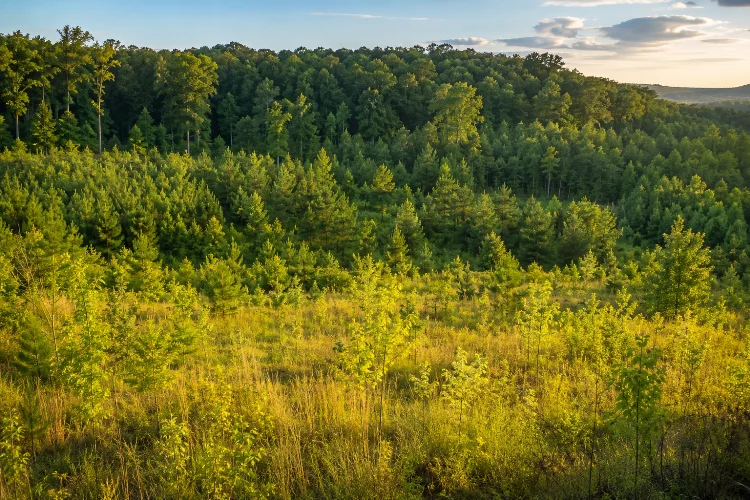
Walk through a young forest and then visit the same place several decades later, and you may barely recognize it.
Small seedlings may have become towering trees, open sunny ground may be covered by a dense canopy, and completely different plants and animals may now occupy the area.
This transformation is part of a natural ecological process. Understanding how forests naturally change through different stages of development helps explain why forests are never truly static.
They grow, compete, mature, experience disturbance, regenerate, and sometimes begin the cycle again. Ecologists often describe these changes through ideas such as forest succession and stand development.
Although every forest follows its own path depending on climate, species, soil, and disturbance history, many forests pass through recognizable developmental stages.
The USDA Forest Service, for example, describes stages including stand initiation, stem exclusion, understory reinitiation, and old-growth development.
Understanding these stages gives us a much better picture of how forests survive and evolve across decades or even centuries.
Forest Development Is a Continuous Process
Before discussing individual stages, it is important to understand that forests do not move through perfectly separated steps.
Nature has no calendar telling a forest when it must become “mature.” Instead, forest development happens gradually as trees grow, die, compete, reproduce, and respond to changes in their enviroment.
Ecologists use developmental stages because they make this continuous process easier to understand.
The exact pathway depends heavily on location. A tropical rainforest, boreal forest, temperate oak woodland, and dry pine forest will develop differently.
Even two nearby forests can follow different trajectories if one experiences wildfire while another is affected mainly by storms or insects.
The USDA Forest Service notes that succession refers to changes in vegetation through time following disturbance. A simplified sequence might move from grasses and herbs to shrubs, young trees, mature forest, and eventually old-growth conditions.
So rather than thinking of forests as finished landscapes, it is more useful to see them as ecosystems continually responding to previous conditions.
Stage 1: Stand Initiation and Early Regeneration
A new development cycle often begins after a major disturbance.
Wildfire, hurricanes, landslides, insect outbreaks, logging, or other events can remove much of the existing tree canopy. Suddenly, sunlight reaches the ground and growing space becomes available.
This period is commonly called stand initiation.
Plants may regenerate from surviving roots, seeds stored in the soil, or seeds carried into the area by wind and animals. Grasses, wildflowers, shrubs, and rapidly growing pioneer trees can quickly take advantage of abundant sunlight.
According to Forest Service descriptions of stand development, grasses, herbs, and shrubs can sometimes dominate disturbed sites for decades before trees fully occupy the area.
This early stage can look messy compared with a mature woodland, but it is ecologically important.
Flowers may support pollinating insects, shrubs provide food and shelter for wildlife, and young vegetation rapidly converts sunlight into new biomass. Pioneer species can also improve conditions for species that arrive later.
Stage 2: Young Trees Begin Competing for Resources
Eventually, successful seedlings grow into saplings and young trees.
At first, there may be enough sunlight, water, nutrients, and physical space for many individuals to grow quickly. But that abundance does not last forever.
As trees become larger, their crowns expand and roots occupy more soil. Competiton for resources becomes increasingly intense.
Some trees grow faster and reach better positions in the canopy. Others remain smaller and receive less light. Shade-intolerant plants that once dominated the forest floor may begin disappearing as the canopy closes.
This transition leads toward what forest ecologists call the stem exclusion stage.
The USDA Forest Service explains that during stem exclusion, trees have occupied most available growing space and establishment of additional trees becomes difficult. Dense crowns reduce light at ground level, while existing trees compete strongly for resources.
A forest at this stage may contain thousands of young trees, but not all of them will survive.
Stage 3: Stem Exclusion and Natural Thinning
Competition becomes especially visible during stem exclusion.
Trees are packed relatively close together, and the canopy may become almost continuous. Those with access to more sunlight continue growing rapidly, while suppressed individuals become weaker.
Eventually, some trees die.
This process is known as self-thinning or natural mortality. It reduces the number of trees while allowing surviving individuals access to more water, nutrients, sunlight, and physical growing space.
Dead trees are not wasted.
Standing dead trees can provide habitat for birds, insects, fungi, and other organisms. Fallen trunks slowly decompose, returning nutrients to the soil while creating habitat for mosses, seedlings, salamanders, and microorganisms.
Forest Service research describes natural thinning as an important part of stand development as competition among densely spaced trees increases.
Although the forest may look less diverse at ground level during this stage because heavy shade suppresses vegetation, important structural changes are already preparing it for the next phase.
Stage 4: Understory Reinitiation Creates New Layers
A dense forest canopy does not remain perfectly closed forever.
Individual trees eventually die, lose branches, or fall during storms. These events create small openings called canopy gaps.
Suddenly, sunlight reaches parts of the forest floor again.
Seedlings that had survived quietly in deep shade may begin growing faster. New plants can also establish in the newly available space.
This stage is commonly known as understory reinitiation.
Forest Service descriptions explain that as mature overstory trees gradually die, openings allow additional sunlight to reach lower vegetation and encourage a new generation of trees beneath the existing canopy.
The forest therefore becomes more vertically complex.
Instead of one relatively even layer of trees, there may now be mature canopy trees, smaller intermediate trees, saplings, shrubs, and ground vegetation.
That structual diversity can create a greater variety of habitats and environmental conditions within the same forest.
Stage 5: Mature Forests Become More Structurally Complex
As decades pass, surviving trees become larger and the forest becomes more structurally diverse.
A mature forest often contains large trees, canopy gaps, fallen logs, standing deadwood, younger trees, and multiple layers of vegetation. However, there is no single age when every forest officially becomes mature.
Species grow at different rates, and climate strongly affects development.
A fast-growing forest in a productive temperate environment may acquire mature characteristics relatively quickly, while forests in colder or drier climates may develop much more slowly.
Importantly, mature does not necessarily mean old growth.
The Forest Service notes that mature and old-growth forests can be challenging to define because characteristics differ among forest types.
Researchers commonly consider factors such as tree age and size, structural diversity, deadwood, canopy layers, species composition, and ecosystem function.
Maturity is therefore better understood as a developmental condition rather than simply a birthday.
Stage 6: Old-Growth Forests Develop Complex Structures
If a forest avoids major stand-replacing disturbance for long enough, it may develop characteristics associated with old growth.
Old-growth forests often contain trees of dramatically different ages and sizes. Large old trees may stand beside younger individuals growing within canopy gaps.
Deadwood also becomes increasingly important.
Large fallen trunks can remain on the ground for many years, slowly decomposing and storing moisture. Standing dead trees provide nesting and feeding opportunities, while cavities in old trees create shelter for wildlife.
The forest becomes a mosaic rather than a uniform collection of trees.
Forest Service research describes old-growth development as a gradual process in which mature canopy trees die individually and younger understory trees eventually replace them. Over long periods, this can create uneven-aged forests with several vegetation layers.
However, many forests never reach this stage before another major disturbance occurs.
Disturbance Can Reset or Redirect Forest Development
Forest succession is not always a one-way journey from young vegetation to ancient woodland.
Disturbances can interrupt development at virtually any stage.
A severe wildfire might remove most trees and return an area to stand initiation. A smaller fire could thin vegetation without completely restarting succession.
Storms may create scattered canopy gaps. Insects might selectively kill one tree species while leaving others alive.
Forest Service guidance illustrates how severe disturbance can return different successional stages to stand initiation, while moderate disturbances may create alternative development pathways.
This is why forest landscapes often contain patches of different ages.
One section may have burned recently and contain grasses and young seedlings. Another may be a dense middle-aged stand, while a nearby protected patch contains large old trees.
That variety is not necessarily evidence that something has gone wrong. In many natural landscapes, it is part of normal forest dynamics.
Forest Succession Does Not Always End at One “Climax” Stage
Older ecological models sometimes presented succession as a predictable march toward a stable climax community.
The idea is useful for introducing succesion, but modern forest ecology recognizes that reality is usually more complicated.
Climate changes. Fires occur. Trees die. New species arrive. Insects spread. Floods and storms reshape landscapes.
Even old forests remain dynamic.
For example, the National Park Service explains that disturbance can interrupt established forest communities and allow grasses, shrubs, aspen, and other species to occupy newly opened areas before later tree communities recover.
Rather than having one permanent final state, many forests continuously shift among developmental conditions.
Their history matters just as much as their age.
A 100-year-old forest that developed after intense fire may look very different from a 100-year-old forest shaped by repeated low-intensity disturbances.
Why Understanding Forest Development Matters
Knowing how forests develop helps conservationists, land managers, researchers, and everyday visitors interpret what they see.
A young forest should not automatically be considered unhealthy simply because it lacks giant trees. Likewise, an old forest is valuable for more than the age of its trees.
Different stages support different ecological functions.
Early successional areas can provide abundant flowers, berries, grasses, and habitat for species that prefer open environments. Mature and old forests may provide large tree cavities, stable shade, complex canopies, and substantial deadwood.
Forest management can therefore benefit from maintaining a mixture of developmental stages across a landscape rather than trying to make every area look identical.
Research also shows that disturbance history, land use, environmental conditions, and regeneration patterns can strongly influence how individual forests develop.
Understanding those differences becomes even more important as climate change alters temperatures, drought patterns, fire regimes, and species distributions.
Forests are constantly developing, even when their changes happen too slowly for us to notice.
They may begin with grasses, shrubs, and seedlings after disturbance, progress into dense young stands, experience natural thinning, develop new understory layers, and eventually acquire mature or old-growth characteristics.
But forest development is not a simple straight line. Fire, storms, insects, climate, competition, and countless smaller events can redirect the process at any moment.
Understanding these natural stages gives us a better appreciation of forests as dynamic living systems rather than static collections of trees.
The next time you visit a woodland, look at the different tree sizes, canopy gaps, fallen logs, and young seedlings. Try to identify where that forest might be in its developmental story-and what clues reveal where it may be heading next.