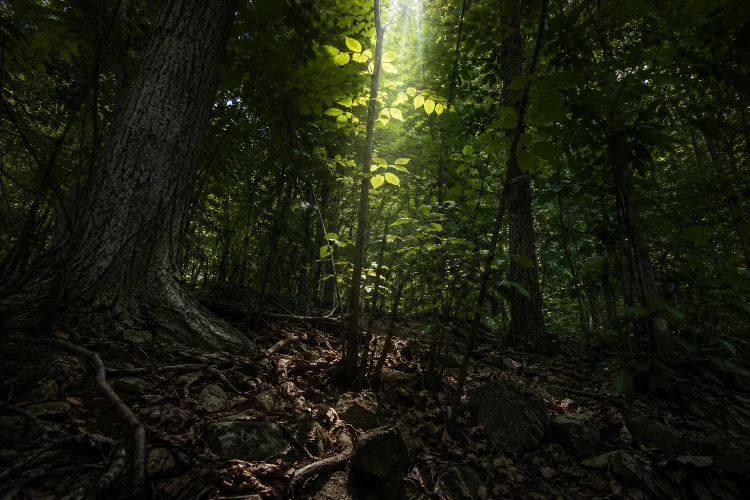
A forest can look calm from the outside, but every patch of green is part of an ongoing competition. Tall trees stretch toward the sun, seedlings wait for openings in the canopy, and roots spread through the soil searching for moisture and minerals.
This hidden struggle helps explain how forest plants compete for light, water, nutrients, and growing space.
Every plant needs the same basic resources, but those resources are limited. As vegetation becomes denser, obtaining enough of them becomes increasingly difficult.
Competition does not simply determine which plant grows fastest. It can influence tree height, crown shape, root development, seedling survival, species composition, and even the future structure of an entire forest.
USDA Climate Hubs notes that plants compete aboveground for light and belowground for resources such as water, nitrogen, and phosphorus.
Understanding this process makes a forest much easier to read. The size of a tree, the darkness beneath a canopy, and even an empty patch of ground can reveal which plants are winning-or losing-the struggle for resources.
Why Forest Plants Have to Compete
Plants need sunlight, water, mineral nutrients, carbon dioxide, and physical space to grow. Carbon dioxide is generally available through the atmosphere, but the other resources can become strongly limited within a crowded forest.
A young woodland may initially contain plenty of open space. As trees grow taller and their crowns and root systems expand, however, demand for resources increases.
Oregon State University Extension explains that competition intensifies as trees become larger because each individual requires more light, moisture, nutrients, and space. Eventually, a site can no longer provide every tree with everything it needs.
This means competiton is closely connected to forest density. A tree that grows rapidly in an open clearing may grow much more slowly when surrounded by dozens of equally demanding neighbors.
Competition also happens between different types of plants. Trees may compete with shrubs, vines, grasses, ferns, and even very small seedlings occupying the same site.
Competition for Light Happens Above the Ground
Of all the resources plants compete for, sunlight is one of the easiest to observe.
Trees need light for photosynthesis, the process that allows them to convert light energy into chemical energy used for growth. In a forest, however, sunlight is distributed very unevenly.
Large trees that reach the upper canopy can intercept enormous amounts of incoming light. Their leaves cast shade on smaller trees and understory plants below them.
Penn State Extension describes forest tree crowns as dominant, codominant, intermediate, or suppressed depending partly on their position and access to sunlight.
Dominant trees receive abundant light, while suppressed trees remain beneath larger crowns and receive much less.
This creates a major advantage for tall plants.
Unlike water or dissolved soil minerals, light cannot be shared equally. A leaf that intercepts sunlight prevents much of that energy from reaching leaves directly underneath it.
Shade Tolerance Changes the Competition
Not every plant responds to shade in the same way.
Some species are highly shade-tolerant and can survive for years beneath a forest canopy. They may grow slowly while waiting for a nearby tree to fall and create a canopy gap.
Other species need intense sunlight. These shade-intolerant plants often grow rapidly after wildfire, logging, storms, or other disturbances open the canopy.
This difference helps explain why forest composition changes over time. A species that dominates an open site may eventually struggle as taller vegetation creates deeper shade.
Roots Compete for Water Beneath the Forest Floor
While branches compete aboveground, another competition is happening where we cannot see it.
Tree, shrub, grass, and herb roots spread through the soil searching for water. Where root systems overlap, nearby plants may draw moisture from the same limited supply.
Competition becomes particularly intense during dry periods.
A large tree with an extensive root system may have access to a much larger soil volume than a small seedling.
However, different species use different strategies. Some develop deeper roots, while others concentrate fine roots near the surface where rainfall and decomposing organic matter provide resources.
USDA Climate Hubs identifies reducing competition for soil moisture as one way forest managers can improve the ability of selected trees to cope with drought and increasing temperatures.
Water competition also changes with the enviroment. It may be relatively mild after prolonged rainfall but become a major factor during drought.
That is one reason seedlings that appeared healthy during spring can struggle later in a dry summer.
Plants Also Compete for Soil Nutrients
Water is not the only prize hidden underground.
Plants require mineral nutrents such as nitrogen, phosphorus, potassium, calcium, and magnesium. These elements support processes ranging from leaf production and photosynthesis to root development and reproduction.
The problem is that nutrients are not distributed evenly through forest soils.
Dead leaves, decomposing logs, animal waste, fungi, microorganisms, soil type, and moisture all influence where nutrients become available.
Roots tend to proliferate in favorable patches, increasing the possibility that neighboring plants will compete for the same resources.
FAO notes that competition for light, water, and nutrients is an important consideration wherever trees and other plants grow together. It also highlights nitrogen and phosphorus as important limiting nutrients in many ecosystems.
But forest plants do not rely only on brute-force root growth.
Many trees form relationships with mycorrhizal fungi. Fungal networks can extend beyond the plant’s own roots and improve access to certain nutrients and water in exchange for carbohydrates produced by the plant.
Competition underground is therefore mixed with cooperation and other ecological interactions.
Growing Space Is More Than Empty Ground
When foresters talk about growing space, they do not mean only the physical distance between tree trunks.
Growing space includes access to canopy area, soil volume, light, water, and nutrients. A plant needs enough three-dimensional space to expand both above and below ground.
As neighboring trees grow, their crowns begin touching and their roots increasingly overlap. Eventually, the stand becomes crowded.
Oregon State University describes increasing stand density as a progression in which trees gradually occupy more of the resources available on a site.
As competition increases, lower branches may become shaded and die, understory vegetation may decline, and tree growth can slow.
This explains why planting twice as many trees in an area does not necessarily produce twice as much long-term tree growth.
There is a limit to how much living plant material a site can support with its available resources.
Competition Can Change the Shape of a Tree
Forest competition leaves visible clues.
A tree growing alone in an open field may develop a broad crown with branches extending in nearly every direction. The same species growing inside a dense woodland may develop a narrower crown and a taller, straighter trunk.
The difference largely comes from resource availablity.
When neighboring trees block light from the sides, a tree has a strong incentive to invest in vertical growth. Lower branches that receive too little sunlight may eventually die, a process sometimes called self-pruning.
Suppressed trees may remain small for years. If competition becomes too severe, they can eventually die, leaving more resources for surviving trees.
This natural mortality is one reason the number of trees in a forest often decreases as a stand becomes older, even though the surviving trees become much larger.
Competition Helps Shape Forest Diversity
Competition may sound entirely negative, but it is a basic ecological process that helps organize plant communities.
Different species have different strengths.
One plant may grow quickly in bright sunlight, while another survives better under shade.
Some perform well in dry soils, while others are stronger competitors where moisture is plentiful. Certain plants thrive on nutrient-rich sites, while others tolerate relatively poor soils.
These differences prevent every forest from being dominated by exactly the same species.
Research in tropical plant communities has also shown that competitive relationships can change over time as trees, palms, and other perennial plants develop and alter access to light and nutrients.
The winner of a competition today, therefore, may not necessarily remain dominant decades later.
Disturbance can change the balance again. When a large tree falls, additional sunlight and growing space suddenly become available, giving smaller plants an opportunity to respond.
What Happens When Competition Becomes Too Strong?
As forest density increases, some plants eventually receive too few resources to maintain rapid growth.
Growth slows first. Trees may produce smaller crowns, shorter annual shoots, or less root development.
If stress continues, weaker individuals can become more vulnerable to drought, insects, disease, and other pressures.
This is why foresters sometimes use thinning.
Removing selected trees reduces competition and redistributes resources to those that remain.
USDA Forest Service research notes that reducing stand density through thinning can increase growing space and the availability of light, water, and nutrients for remaining vegetation.
USDA Climate Hubs similarly identifies thinning as a method that can reduce competition and improve the survival or growth of selected trees, particularly where moisture becomes limiting.
In a natural forest without management, similar changes occur through tree mortality, storms, fire, insects, and canopy-gap formation.
Why Seedlings Face the Toughest Competition
Young seedlings are especially vulnerable because they begin life surrounded by established plants.
A mature tree may already have an enormous crown and root network. A newly germinated seed has only tiny leaves and a small root system.
The seedling must find enough sunlight while competing with herbs, shrubs, ferns, neighboring seedlings, and adult trees for water and soil resources.
Penn State Extension notes that competing vegetation can interfere with successful forest regeneration because only limited space, water, nutrients, and sunlight are available for plant growth.
Yet seedlings have strategies of their own.
Some remain dormant or grow slowly in shade. Others produce large numbers of seeds so at least a few individuals reach favorable locations. Pioneer species may grow extremely quickly once disturbance creates an opening.
Those strategies help determine which species become part of the next generation of forest.
Forest plants may appear motionless, but they are constantly responding to their neighbors.
Trees, shrubs, seedlings, grasses, and other vegetation compete for sunlight above the ground while their root systems search for water, nutrients, and usable soil space below.
The outcome of that competition shapes tree growth, canopy structure, regeneration, species diversity, and long-term forest development.
At the same time, no plant is permanently guaranteed an advantage. Drought, storms, falling trees, fire, and other disturbances can suddenly redistribute resources and create new opportunities.
Next time you walk through a forest, look at where sunlight reaches the ground, which trees have broad crowns, where seedlings are growing, and where vegetation becomes sparse.
Those simple observations can reveal the hidden competition that is constantly shaping the woodland around you.