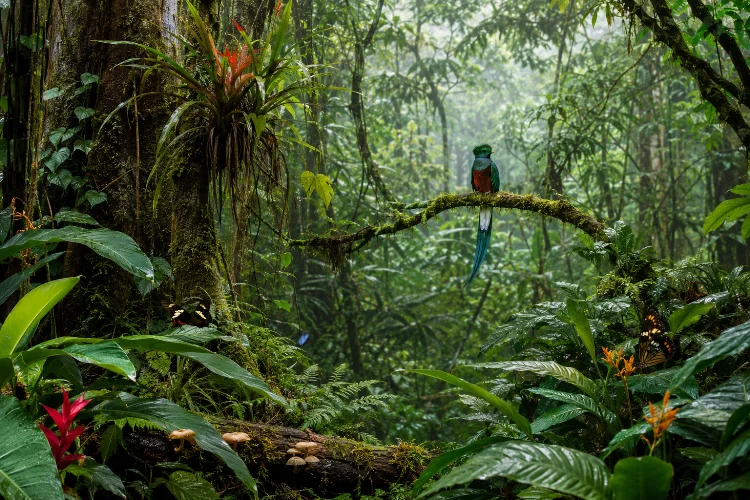
A healthy forest is much more than a large collection of trees. Look closer and you will find insects moving between flowers, fungi growing around roots, birds spreading seeds, mammals shaping vegetation, and microorganisms quietly recycling dead material in the soil.
All of these organisms are connected through biodiversity. Understanding why biodiversity is essential for healthy and resilient forest systems means recognizing that different species perform different jobs.
Some capture sunlight, others pollinate plants, control pests, disperse seeds, decompose organic matter, or help nutrients move through the ecosystem.
Forests contain much of Earth’s terrestrial biodiversity, and tropical rainforests alone support an enormous variety of species. Their biological richness helps maintain processes such as carbon storage, water regulation, nutrient cycling, and regeneration.
Biodiversity becomes especially important when forests face drought, wildfire, pests, storms, or climate change. A forest with many ecological strategies has more ways to respond when conditions suddenly change.
In simple terms, diversity gives forests options.
Forest Biodiversity Is More Than the Number of Tree Species
When people hear the word biodiversity, they often imagine a forest containing many different tree species. Species richness is important, but biodiversity is much broader.
It includes trees, shrubs, grasses, mosses, fungi, mammals, birds, reptiles, insects, bacteria, and other organisms. It also includes genetic variation within individual species and differences in ecological roles.
A forest containing ten tree species that all behave similarly may function differently from one containing species with different root depths, growth rates, leaf structures, drought tolerances, and nutrient requirements.
Ecologists sometimes call this functional diversity.
Functional differences matter because they allow organisms to use resources in different ways.
Research from forest biodiversity experiments shows that increasing tree diversity can improve multiple ecosystem functions through resource partitioning, facilitation, and interactions among species.
That means forest health depends not only on how many species exist, but also on what those species actually do.
Biodiversity Helps Forests Use Resources Efficiently
Imagine two tree species growing side by side.
If both have shallow roots, similar crowns, and identical nutrient requirements, they may compete strongly for the same resources. But if one develops deeper roots while another uses moisture near the soil surface, they can occupy slightly different ecological niches.
The same principle applies to light and nutrients.
Different trees may produce leaves at different heights, grow at different times of year, or rely on different relationships with soil fungi. These differences allow mixed forests to capture resources more completely than communities where every plant behaves almost identically.
Studies of forest diversity have found that mixed-species communities can sometimes achieve greater productivity because species complement one another rather than competing for exactly the same resources.
This does not mean competition disappears. Trees still compete for sunlight, water, nutrients, and space.
Instead, greater diverssty can make the entire community more efficient at using what is available.
Diverse Food Webs Keep Forest Ecosystems Functioning
Trees form the physical structure of many forests, but they cannot maintain an ecosystem alone.
Consider what happens when a tree produces fruit.
Birds and mammals may eat the fruit and carry its seeds somewhere else. Insects may pollinate its flowers. Predators control some herbivores that feed on its leaves, while fungi and bacteria eventually decompose fallen material.
Each organism becomes part of a larger food web.
Recent research emphasizes that biodiversity across multiple trophic levels can strongly influence ecosystem functioning.
The relationships among plants, herbivores, predators, decomposers, and other organisms create networks rather than simple one-directional food chains.
A predator disappearing from a forest, for example, can affect prey populations. Those changes may influence vegetation, which can then affect insects, soil processes, and other wildlife.
This is why losing one species does not always produce only one consequence.
Forest organisms are deeply interdependant.
Biodiversity Supports Nutrient Cycling and Healthy Soil
Some of the most important forest activity happens underneath fallen leaves.
Dead branches, animal waste, roots, and leaf litter contain nutrients that would become unavailable if nothing broke them down.
Fungi, bacteria, insects, and other decomposers turn this organic material into forms that plants can reuse. Nutrients such as nitrogen and phosphorus gradually return to the soil and become available for another generation of vegetation.
Different decomposer species work under different conditions and break down different types of material.
Mycorrhizal fungi add another layer to this process. These fungi form relationships with tree roots and can help plants access water and soil nutrients in exchange for carbohydrates created through photosynthesis.
FAO identifies nutrient recycling, tree growth, pollination, seed dispersal, and carbon sequestration among the ecological processes that depend heavily on forest biodiversity.
Without biological diversity underground, forests would have a much harder time recycling the materials needed for continued growth.
Greater Diversity Can Improve Forest Productivity
A forest’s productivity refers to its ability to produce new biological material, including wood, leaves, roots, and other biomass.
Tree diversity can play an important role in that productivity.
A long-term forest biodiversity experiment in subtropical China examined hundreds of plots and more than 190,000 trees. Researchers found that functional diversity became increasingly important for productivity as the experimental forests developed.
One reason is complementarity.
Species with different characteristics may occupy different canopy layers or access water from different depths. Together, they can sometimes make more complete use of available resources than a single-species stand.
The relationship is not identical in every forest. Climate, soil fertility, stand age, density, and the particular species involved all influence the result.
Still, decades of forest biodiversity experiments increasingly show that diverse tree communities can support several ecosystem functions at the same time rather than maximizing only one.
Biodiversity Can Make Forests More Resistant to Drought
Climate change is placing increasing pressure on many forests through rising temperatures, altered rainfall, drought, wildfire, and extreme weather.
A forest dominated by one species can face a serious problem if that particular species is highly sensitive to a new stress.
A more diverse forest spreads that risk.
Some trees may tolerate drought because they have deep roots. Others may conserve water efficiently, shed leaves during stressful periods, or continue growing under conditions that reduce the performance of neighboring species.
A global study using data from more than 0.7 million forest plots found that tree species diversity was associated with greater resistance to extreme drought in many forests.
This does not mean biodiversity makes forests invincible.
Extremely severe drought can still kill large numbers of trees. But biological variety gives a forest a wider range of responses, making it less likely that every species reacts to stress in exactly the same way.
This ecological insurance is an important part of forest resiliance.
Genetic Diversity Helps Species Adapt Over Time
Biodiversity also exists within species.
Two trees of the same species are not necessarily genetically identical. Their genes may influence characteristics such as growth rate, disease resistance, drought tolerance, timing of reproduction, or ability to survive cold temperatures.
This genetic variation becomes extremely valuable when environmental conditions change.
Imagine a tree population experiencing progressively hotter and drier summers. Some individuals may possess traits that allow them to survive these conditions better than others.
Those individuals can reproduce and pass useful traits to future generations.
Without sufficient genetic variation, a species has fewer options for adaptation. Small, isolated populations can be particularly vulnerable if habitat fragmentation reduces genetic exchange.
Maintaining genetic diversity therefore supports the long-term adaptive capacity of forest species, especially as climatic conditions continue to shift.
Biodiversity Can Reduce Vulnerability to Pests and Disease
Forests also face threats from insects, pathogens, and disease outbreaks.
When huge areas are dominated by one highly susceptible species, a specialized pest can potentially move from tree to tree with little resistance.
Greater biological diversity may interrupt that process.
A mixed forest can contain tree species with different levels of susceptibility. Some may be poor hosts for a particular insect or pathogen, potentially slowing its movement through the landscape.
Predators and parasitoids also contribute.
Birds, predatory insects, spiders, and other organisms can help regulate herbivore populations. Research from forest biodiversity experiments has found links among tree diversity, arthropod diversity, predators, herbivores, and overall tree productivity.
However, biodiversity should not be treated as a guaranteed shield against every disease or pest.
The effect depends on which species are present, how the threat spreads, and local enviromental conditions.
Diverse Forests Have More Pathways for Recovery
Disturbance is a normal part of forest life.
Wildfires, storms, droughts, landslides, insects, and falling trees regularly reshape vegetation. The important question is not whether a forest changes, but whether ecological processes can continue afterward.
Biodiversity provides multiple pathways for regeneration.
After a storm removes large canopy trees, shade-intolerant plants may quickly colonize newly sunny gaps. After fire, some species regenerate from surviving roots while others germinate from seeds.
Animals can carry seeds from nearby areas, while decomposers recycle nutrients from dead vegetation.
Research reviewing forest resilience emphasizes that biological diversity can contribute to resistance, recovery, and adaptive capacity as forests respond to climate change and disturbance.
Recent tropical forest research also demonstrates that different groups recover at different speeds. In one study, abundance and diversity across numerous taxonomic groups recovered substantially within several decades, while complete community recovery took longer.
A resilient forest is therefore not one that never changes. It is one capable of reorganizing while continuing essential ecological functions.
Why Protecting Forest Biodiversity Matters
Protecting biodiversity is not simply about preventing species extinction.
It also means protecting the relationships that allow forests to work.
Healthy forest systems contribute to carbon storage, water regulation, soil protection, pollination, nutrient cycling, habitat provision, and human livelihoods. When biodiversity declines, some of these ecological functions can become less stable or less effective.
FAO identifies deforestation as a major driver of forest biodiversity loss, alongside degradation, fragmentation, invasive species, excessive harvesting, fires, pests, and disease.
Conservation therefore requires more than planting large numbers of trees.
Forest restoration should consider native species diversity, genetic variation, wildlife habitat, soil organisms, landscape connectivity, and long-term ecosystem processes.
A plantation containing millions of identical trees may be green, but it does not automatically provide the ecological complexity of a naturally diverse forest.
Biodiversity is one of the foundations of healthy and resilient forest systems.
Trees, fungi, insects, wildlife, microorganisms, and genetic variation work together to support nutrient cycling, food webs, productivity, regeneration, carbon storage, and adaptation to environmental change.
Greater diversity cannot prevent every drought, wildfire, pest outbreak, or climate impact. What it can do is give forests more ecological strategies for responding when conditions change.
Protecting forests, therefore, should mean protecting more than tree cover. It means conserving the complex living networks that make forests function in the first place.
When visiting or learning about a forest, look beyond the largest trees and consider the smaller organisms around them. Those less obvious species may be doing some of the most important work in keeping the entire ecosystem alive.