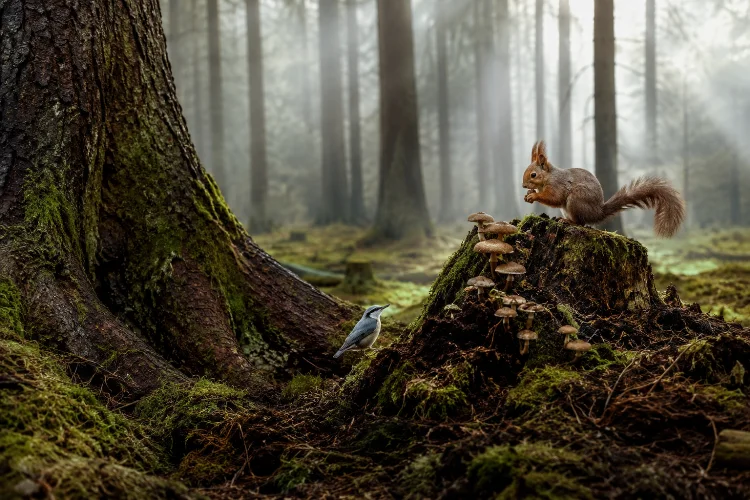
A forest may look like a place dominated by trees, but trees are only part of the story. Beneath the soil, fungi connect with roots, bacteria transform nutrients, insects break down dead wood, and animals carry seeds across the landscape.
Understanding how trees, fungi, animals, and microbes interact inside forest systems reveals something important: forests work because thousands of organisms depend on one another.
Some relationships are cooperative, others involve competition, predation, or disease, but together they create a living network that keeps energy and nutrients moving. Forests are especially rich in these biological connections.
The Food and Agriculture Organization notes that animals, plants, fungi, and microorganisms all contribute to forest biodiversity and ecosystem functions, including pollination, seed dispersal, decomposition, and nutrient cycling.
Once you start seeing a forest this way, even a fallen log becomes interesting. It is not simply dead wood. It can become food, shelter, moisture storage, fungal habitat, microbial territory, and eventually nutrients for future trees.
Trees Create the Framework of the Forest
Trees are often called foundation species because they physically shape much of the forest environment.
Their leaves capture sunlight and produce carbohydrates through photosynthesis. Their branches create habitat, their roots stabilize soil, and their canopies influence temperature, humidity, rainfall interception, and the amount of light reaching the forest floor.
But trees do not build forests alone.
A tree continuously interacts with organisms living on its bark, leaves, roots, flowers, fruits, and surrounding soil. Some organisms provide benefits, while others consume its tissues or compete for resources.
Even dead trees continue influencing forest life. Standing dead trees can provide nesting sites for birds and insects, while fallen trunks become habitats for fungi, bacteria, mosses, seedlings, and small animals.
In this sense, a tree remains part of the ecosystem long after it stops growing.
Fungi Form Powerful Partnerships With Tree Roots
One of the most important forest relationships occurs underground between trees and fungi.
Many trees form partnerships called mycorrhizae, in which fungi associate closely with fine roots. The fungal hyphae extend through soil far beyond the immediate root surface, helping plants obtain water and minerals.
In return, trees provide fungi with carbohydrates produced through photosynthesis.
USDA Forest Service research describes mycorrhizae as symbiotic fungus-root associations that can improve both nutrient and water uptake.
The same research notes that carbon transferred through these relationships can eventually contribute substantially to organic material in forest soils.
This partnership is particularly valuable for accessing nutrients such as nitrogen and phosphorus.
Fungal Networks Are More Complex Than a Simple Trade
Mycorrhizal relationships are sometimes described as underground networks connecting plants. That idea is useful, but the reality is more complicated than trees simply “sharing” resources with friends.
Plants and fungi are biological organisms responding to their own needs. Relationships can change depending on tree species, fungal species, soil conditions, resource availability, and climate.
Still, these partnerships show how deeply connected aboveground and belowground forest processes really are.
A tree reaching toward sunlight may depend partly on microscopic fungal threads hidden beneath its roots.
Animals Help Trees Reproduce and Move
Trees cannot walk to a better location, but their seeds can travel.
Forest animals are among the most important seed transportation systems on Earth. Birds, bats, monkeys, rodents, elephants, and many other creatures eat fruits or carry seeds before depositing them elsewhere.
The Smithsonian reports that more than 80% of tropical tree species can be dispersed by animals. In some forests, successful tree regeneration therefore depends heavily on healthy animal communities.
A bird might eat a fruit in one part of the forest, fly several hundred meters, and later release the seed far from its parent tree.
That movement can reduce competition with the parent, help seeds escape specialized predators, and allow plants to colonize canopy gaps or regenerating areas.
Animals also affect forests through pollination, herbivory, seed predation, digging, trampling, and soil disturbance.
In other words, animals do not simply live among trees. They actively shape where future trees grow.
Microbes Run the Forest’s Hidden Recycling System
A handful of forest soil may contain an extraordinary community of bacteria, archaea, fungi, protists, and other microscopic organisms.
These microbes play a major role in turning dead biological material back into usable resources.
When leaves fall, roots die, animals produce waste, or organisms decompose, nutrients do not automatically become available to plants. Microbial activity helps break complex organic material into simpler forms that can move through the soil ecosystem.
FAO describes soil biodiversity as part of a vast food web responsible for processes such as nutrient cycling, plant growth, soil productivity, water regulation, and carbon storage.
Some bacteria can also transform nitrogen between different chemical forms. Others interact directly with plant roots or fungi.
Forest microbiomes are influenced by tree species, soil chemistry, vegetation structure, and environmental conditions. Recent research continues to show that these microscopic communities are closely linked with forest productivity and ecosystem resiliance.
They may be invisible, but microbes help determine what can grow above them.
Fungi, Insects, and Microbes Turn Dead Wood Into New Life
When a tree falls, decomposition begins another chain of interactions.
Fungi are particularly important because some species can break down tough structural compounds in wood. Wood-decay fungi gradually transform trunks and branches while releasing stored carbon and nutrents.
USDA Forest Service research describes fungi as critical forest organisms involved in wood and litter decay, nutrient recycling, tree symbiosis, and sometimes disease.
Insects join the process as well.
Beetles, termites, and other wood-associated animals create tunnels, fragment material, transport microorganisms, and influence nitrogen dynamics. Bacteria and other microbes then participate in additional stages of decompositon.
The National Park Service notes that rotting logs can eventually release nutrients while providing moisture and shelter for mosses, fungi, seedlings, insects, and other organisms.
What looks like decay is actually recycling.
The molecules that once formed an old tree can eventually become part of soil, fungi, insects, microorganisms, and even a new generation of seedlings.
Forest Food Webs Connect Every Layer of the Ecosystem
Forest interactions are not limited to direct partnerships.
They form complicated food webs.
Leaves feed caterpillars. Caterpillars feed birds. Birds may become prey for hawks. Dead animals support scavengers and decomposers, while their waste returns nutrients to soil organisms.
Predators can indirectly influence vegetation as well.
If predators reduce the abundance or behavior of herbivores, young trees may experience less browsing pressure. If seed-eating animals increase dramatically, tree recruitment can change.
This means an interaction between two animal species can eventually affect plants.
The same principle works underground. Fungi, bacteria, insects, roots, and microscopic predators form their own food networks.
Forest ecosystems therefore operate through layers of direct and indirect relationships rather than isolated species.
Some Relationships Help Trees, While Others Harm Them
Not every forest interaction is cooperative.
Fungi provide a good example.
Mycorrhizal fungi can support tree nutrition, while decomposer fungi recycle dead material. Other fungal species are pathogens capable of damaging living trees.
Insects can be pollinators, decomposers, herbivores, predators, or parasites.
Microbes also vary widely. Some benefit roots, while others cause plant disease.
These apparently negative relationships still influence forest structure. Disease, herbivory, and predation can prevent certain species from becoming overwhelmingly dominant and create opportunities for competitors.
A tree killed by disease may open a canopy gap. Increased sunlight can then allow seedlings, shrubs, and herbs to expand.
Ecological interactions are therefore rarely as simple as “good” or “bad.” Their effects depend on scale, intensity, species, and the wider enviroment.
Animals Can Help Forests Recover After Disturbance
Interactions among plants and animals become especially important when forests are regenerating.
After abandoned agricultural land begins returning to forest, seeds must somehow reach the site. Wind can transport some species, but many tropical trees rely heavily on animals.
Research from the Smithsonian Tropical Research Institute followed natural forest restoration in Panama and found that different groups of animals contributed to seed dispersal at different stages of recovery.
Small birds were particularly important in younger forests, while larger animals became increasingly important as forests matured.
This has an important practical lesson.
Restoring trees without restoring ecological interactions may produce an incomplete ecosystem. Forest conservation needs habitats where pollinators, seed dispersers, predators, fungi, and soil organisms can survive too.
Healthy regeneration depends on relationships, not simply tree numbers.
Soil Connects the Aboveground and Underground Worlds
Forest soil is where many of these interactions eventually meet.
Trees send roots underground. Fungi colonize those roots. Animals deposit waste and organic material. Leaves fall from the canopy. Dead organisms are broken apart by decomposers.
Microbes then process many of those materials.
Research on wood decay shows that fallen trees, roots, leaf litter, fungi, and microorganisms influence soil organic matter, moisture, nitrogen cycling, and other ecosystem processes.
Meanwhile, nutrients released underground support new plant growth aboveground.
The cycle repeats.
This continuous exchange helps explain why removing one component can influence many others. Losing animals may reduce seed dispersal. Losing fungi can alter nutrient uptake. Changes in tree diversity can reshape microbial communities.
Forest health comes from maintaining connections across the whole system.
Why These Forest Interactions Matter
Understanding forest interactions changes the way we think about conservation.
Saving trees is obviously important, but protecting tree cover alone does not necessarily preserve a functioning forest.
A healthy ecosystem also needs fungi that support roots and decompose wood, animals that pollinate flowers and transport seeds, microorganisms that recycle organic material, and predators that influence food webs.
FAO emphasizes that forests contain interconnected communities of plants, animals, fungi, and microorganisms whose activities maintain biodiversity and ecosystem functions.
These relationships also influence carbon cycling, soil fertility, regeneration, forest productivity, and resilience after disturbance.
Protecting forest systems therefore means protecting ecological interactions-not merely individual species.
Forests function because countless organisms are constantly interacting.
Trees capture energy and create habitat, fungi connect with roots and break down wood, animals pollinate plants and move seeds, while microbes recycle nutrients that support future growth.
Some relationships involve cooperation, while others involve competition, herbivory, disease, and predation. Together, they create a dynamic ecosystem capable of recycling materials and responding to environmental change.
The next time you enter a forest, look beyond the biggest trees. Notice mushrooms on fallen wood, insects beneath bark, birds eating fruit, and decomposing leaves under your feet.
Each is part of a much larger network. Understanding those connections is one of the best ways to appreciate why protecting complete forest ecosystems-not simply tree cover-is so important.