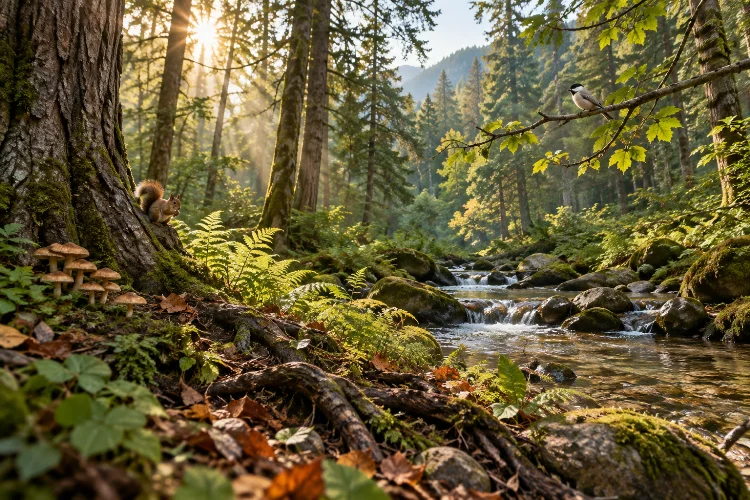
Walk into a forest and the first things you probably notice are the living ones. Tall trees stretch toward the sunlight, birds move between branches, insects crawl under leaves, and perhaps a squirrel disappears behind a trunk.
But a forest is shaped by much more than the organisms we can see. Sunlight, temperature, rainfall, soil, minerals, air, and water all influence which plants can grow and which animals can survive.
At the same time, living organisms continuously modify those nonliving conditions. Tree roots change soil structure, fallen leaves add organic matter, and plant canopies affect light, humidity, and temperature near the forest floor.
Understanding how living and nonliving components shape a forest ecosystem helps us see a forest as a connected system rather than simply a collection of trees.
Ecologists usually describe these components as biotic factors, meaning living organisms, and abiotic factors, meaning nonliving parts of the enviroment.
Neither group works independently. Their constant interaction determines how forests develop, function, and respond to change.
A Forest Ecosystem Is a Network of Relationships
A forest ecosystem includes all the organisms living in a particular forest together with the physical conditions surrounding them.
That means a deer, an oak tree, a mushroom, rainfall, soil minerals, and sunlight may all belong to the same ecological system. What makes the forest interesting is not simply that these components exist, but that they influence one another.
A change in one part can create effects elsewhere. If rainfall decreases for several years, trees may experience water stress. Reduced tree growth can then change the amount of food and shelter available to insects, birds, and mammals.
Similarly, losing a major animal species can affect seed dispersal, plant competition, or predator-prey relationships.
This interconnectedness is why ecosystems are often described as networks rather than simple chains.
Living Components: The Biotic Side of the Forest
Biotic components include plants, animals, fungi, bacteria, and other organisms living within the forest.
Each group plays a different ecological role, but most organisms depend on several others to survive.
1. Producers Build the Biological Foundation
Plants are the main producers in most forest ecosystems.
Trees, shrubs, grasses, mosses, and other plants capture solar energy through photosynthesis and convert it into chemical energy stored in organic matter. That energy eventually becomes available to animals, fungi, and microorganisms.
Trees also provide physical habitat. Their trunks may shelter insects, branches offer nesting sites for birds, and roots create underground environments used by countless organisms.
Different forests support different vegetation because temperature, rainfall, soil, and sunlight vary between regions.
2. Consumers Move Energy Through the Food Web
Animals obtain energy by eating plants or other organisms.
Herbivores such as deer, caterpillars, and some rodents consume vegetation. Predators eat other animals, while omnivores may consume both plant and animal material.
These feeding relationships create complex forest food webs.
Predators can influence herbivore populations, herbivores affect plant growth, and fruit-eating animals can help plants reproduce by carrying seeds to new locations. Even relatively small changes in these interacions can influence the wider community.
3. Decomposers Recycle What the Forest No Longer Uses
A fallen tree may look dead, but ecologically it can remain extremely active.
Fungi, bacteria, insects, worms, and other decomposers gradually break down dead organisms and organic material. During this process, nutrients are returned to the soil, where plants can use them again.
Without decompsers, dead leaves, branches, and organisms would accumulate while many essential nutrients remained trapped inside them.
Nonliving Components Set the Conditions for Life
Abiotic factors create the physical conditions in which forest organisms must survive.
Important examples include sunlight, air, water, soil, temperature, rainfall, humidity, wind, minerals, and topography.
Sunlight is particularly important because plants depend on it for photosynthesis. Yet light is not distributed equally throughout a forest. The canopy may receive strong sunlight while the forest floor remains shaded.
That difference helps explain why shade-tolerant plants often grow beneath mature trees while other species struggle there.
Temperature and precipitation are equally important. Together with soil and light availability, they strongly influence what type of terrestrial ecosystem can develop in a particular region.
Soil Connects Living and Nonliving Parts of the Forest
Forest soil is a perfect example of how the biotic and abiotic worlds overlap.
Soil contains minerals, water, and air, but it also contains roots, microorganisms, insects, fungi, and decomposing organic material.
National Geographic describes soil as containing both biotic and abiotic components, making it one of the most important meeting points between living organisms and their physical surroundings.
Fallen leaves add organic material to the soil. Microorganisms break this material down, releasing nutrents that plants absorb through their roots.
Roots then affect the soil in return. They can stabilize the ground, create spaces where water and air move, and contribute additional organic matter when they die.
Healthy soil therefore supports vegetation, while vegetation continuously helps create and protect healthy soil.
Energy Flow and Nutrient Cycling Keep the Forest Running
Energy and nutrients behave differently inside an ecosystem.
Most energy begins with sunlight. Plants capture some of this energy, herbivores obtain it by eating plants, and predators receive some by eating other organisms.
At every stage, some energy is used by organisms and eventually released as heat. Because energy is constantly lost from the biological system, forests require a continuous energy supply from the sun.
Nutrients such as nitrogen and phosphorus operate differently because they can be recycled.
Plants absorb nutrients from soil, animals obtain them through food, and decomposition eventually returns many of those materials to the environment.
These cycles show why even dead organisms remain important to a living forest.
Water Shapes Forest Life Above and Below the Ground
Water affects almost every major process inside a forest.
Trees need it for photosynthesis, transporting nutrients, maintaining cells, and growing new tissue. Animals depend on water directly and also indirectly through the plants and prey they consume.
Forests also influence water themselves. Vegetation can intercept rainfall, while forest litter and soil help water soak into the ground.
According to the Food and Agriculture Organization, forested watersheds supply roughly 75 percent of accessible freshwater worldwide and play important roles in regulating water quantity and quality.
However, both too little and too much water can cause problems. Drought may weaken trees, while prolonged waterlogging can reduce oxygen around roots and harm species that are not adapted to saturated conditions.
Climate and Disturbance Can Reshape the Entire System
Forests are dynamic rather than permanently stable.
Natural events such as storms, droughts, floods, fires, insect outbreaks, and tree falls can alter both living communities and physical conditions.
A large tree falling, for example, creates an opening in the canopy. Suddenly, more sunlight reaches the forest floor. That abiotic change may allow young plants to grow rapidly, attracting insects and herbivores that were previously uncommon in the shaded area.
Disturbance is therefore not automatically harmful. Some ecosystems naturally depend on periodic fires, storms, or other events.
Problems become more serious when disturbances occur too frequently, become unusually intense, or combine with pressures such as habitat fragmentation and climate change.
Rising temperatures and changing precipitation patterns can affect forest productivity, species distributions, moisture availability, and forest health.
Why Biotic and Abiotic Connections Matter for Forest Conservation
Protecting a forest means protecting ecological relationships, not simply keeping a certain number of trees standing.
Removing vegetation can change shade, soil moisture, erosion, water flow, habitat availability, and nutrient cycling at the same time.
Likewise, damaged soil can make it difficult for trees to regenerate even when seeds are available. Pollution can alter water chemistry, while the disappearance of important pollinators or seed dispersers may reduce plant reproduction.
Effective forest management therefore considers vegetation, wildlife, soils, water systems, climate, and natural disturbances together.
This wider view is important because forests provide more than habitat. They support biodiversity, help protect soils and water, store carbon, influence local climates, and provide resources and livelihoods for people around the world.
A forest ecosystem works because living and nonliving components are constantly influencing one another.
Plants capture sunlight, animals move energy through food webs, decomposers recycle nutrients, and soil provides water and minerals. At the same time, temperature, rainfall, sunlight, topography, and other abiotic conditions determine which organisms can survive in the first place.
The result is a constantly changing ecological network rather than a simple collection of trees and animals.
Understanding these connections makes it easier to understand why changes to climate, water, soil, vegetation, or wildlife can affect an entire forest.
The next time you visit a woodland, look beyond the trees. Notice the moisture, shade, soil, fallen leaves, insects, fungi, and flowing water. Each one tells part of the story of how the forest stays alive.